Fused CSG
The solid of Basic CSG built as a fused composition (see Fused composition): a shape
whose type spells out the whole tree, evaluated with nothing to interpret. The source is at
Examples/FusedCSG/main.cpp.
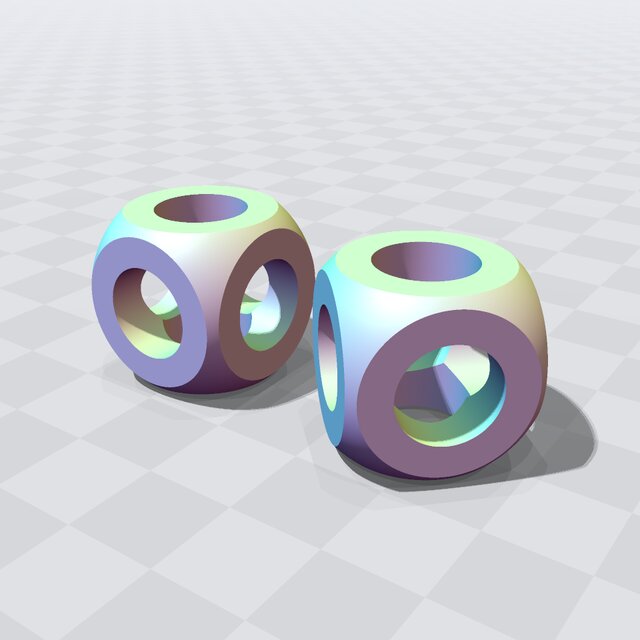
Fig. 23 The scene of two fused parts.
Building it fused
The functions in namespace Fused (EBGeometry_Fused.hpp) are the builder’s operations as types. They are called
qualified (Fused::Union, not Union, which is the builder’s), and where the builder takes a
std::vector they take the operands as arguments:
const auto fused = Fused::Difference(Fused::Intersection(cube, ball), drillX, drillY, drillZ);
Against the tape
The program builds the same solid through the builder and a Tape and prints both values at a point,
which are the same to rounding, and the time per point of each on the host: the tape fetches and
dispatches each clause, the fused solid has nothing to interpret.
Fused parts in a tape
A fused solid is one shape with one surface. Listed after T it is one leaf of a tape, so a scene
known only at run time can place compiled parts, and closestPrimitive() names the part:
const Tape<T, FusedSolid> scene(pool, Union(Expr<T>(fused), Translate(Rotate(fused, 45, 1), Vec3(3, 0, 0))));
The same query on a GPU
The fused solid holds its shapes, not offsets into a pool, so it goes to the device as it is:
GPU::transform(Distance<FusedSolid>{fused}, line, values), with nothing to mirror.
Looking at it
The example ends with Render::view(scene, pool, argc, argv), a window on the scene of two fused parts.
The window needs SDL2 and is built with make VIEWER=SDL2 or cmake -DEBGEOMETRY_VIEWER=SDL2 (see
The viewer window (EBGEOMETRY_VIEWER)); otherwise, and with --no-view or without a display, view() prints why
and returns. Drag to orbit and scroll to zoom; the window lists its other keys (see
The viewer’s keys).
Building and running
See Building for how to compile it with CMake, GNU Make, or a direct compiler invocation, and Running on a GPU for a GPU build.
cd Examples/FusedCSG
./FusedCSG.ex