Transforms
One object moved, turned, scaled, mirrored and stretched (repeating it is Repetition). A
transform applies to a whole expression and changes where the object is, not what it is. The source is at
Examples/Transforms/main.cpp.
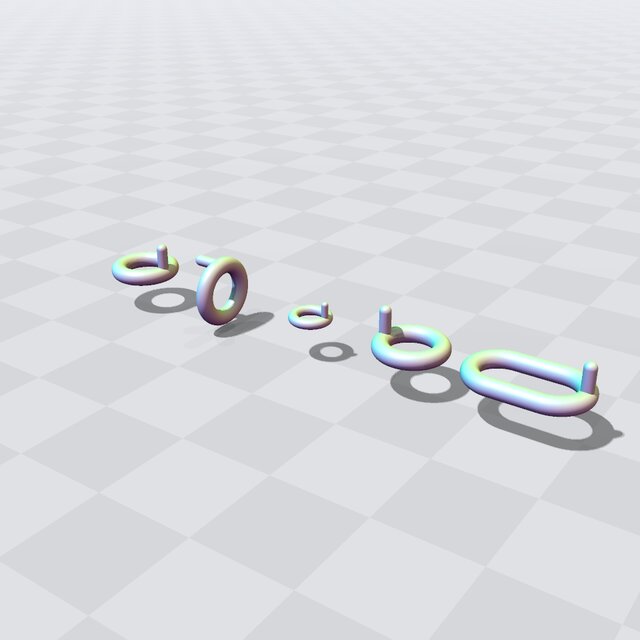
Fig. 20 The object as built, rotated, scaled, reflected and elongated.
The transforms
The object is a ring around the \(y\) axis with a post on its \(+x\) side, so that every transform shows:
Translate(e, shift)moves it.Rotate(e, degrees, axis)turns it about a coordinate axis (0, 1, 2) or about any direction.Scale(e, factor)scales it uniformly about the origin, which keeps a distance a distance.Reflect(e, axis)mirrors it in a coordinate plane.Elongate(e, halfLengths)stretches it by inserting a box at the origin.
The program prints each result’s bounding box.
Looking at it
Translate sets the five results out in a row, compiled into one tape. A union of this many
operands is evaluated through a BVH over their boxes (see BVH-accelerated unions).
The window needs SDL2 and is built with make VIEWER=SDL2 or cmake -DEBGEOMETRY_VIEWER=SDL2 (see
The viewer window (EBGEOMETRY_VIEWER)); otherwise, and with --no-view or without a display, view() prints why
and returns. Drag to orbit and scroll to zoom; the window lists its other keys (see
The viewer’s keys).
Building and running
See Building for how to compile it with CMake, GNU Make, or a direct compiler invocation. Built for a GPU (see Running on a GPU), the window renders on the device.
cd Examples/Transforms
./Transforms.ex