Repetition
Many copies of one object on a grid with FiniteRepetition; here a mesh, the happy Buddha. The source
is at Examples/Repetition/main.cpp.
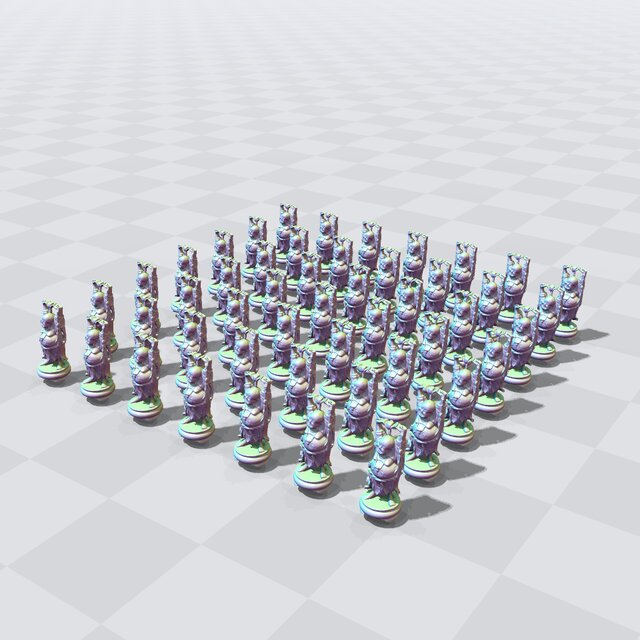
Fig. 21 49 copies of the happy Buddha from one FiniteRepetition.
Important
The default mesh comes from the common-3d-test-models git submodule. Clone with
--recurse-submodules, or run git submodule update --init in the repository (see
Obtaining EBGeometry); otherwise pass a mesh of your own as the first argument.
Repeating a mesh
The mesh is read into a TriMeshSDF, scaled to height 1 and stood on \(y = 0\) with Scale and
Translate. FiniteRepetition(object, period, lo, hi) tiles it with the given period, lo and
hi tiles to either side of the home tile along each axis:
const Expr grid = FiniteRepetition(statue, Vec3(0.8, 1, 0.8), Vec3(3, 0, 3), Vec3(3, 0, 3)); // 7 x 7
The tape stores the object once and evaluates it as a sub-program: each point is folded into the tile it lies in, and only the copies whose boxes come closer than that copy’s value are evaluated after it.
Against a union of copies
The program also places the same 49 copies one by one with Translate in a Union, which the tape
evaluates through a BVH over their boxes (see BVH-accelerated unions). Both give the same values; the
program prints each tape’s number of clauses, which grows with the copies only for the union, and the
time per point of each.
Looking at it
The example ends with Render::view(repeated, pool, argc, argv), a window on the grid of statues.
The window needs SDL2 and is built with make VIEWER=SDL2 or cmake -DEBGEOMETRY_VIEWER=SDL2 (see
The viewer window (EBGEOMETRY_VIEWER)); otherwise, and with --no-view or without a display, view() prints why
and returns. Drag to orbit and scroll to zoom; the window lists its other keys (see
The viewer’s keys).
Building and running
See Building for how to compile it with CMake, GNU Make, or a direct compiler invocation. Built for a GPU (see Running on a GPU), the window renders on the device.
cd Examples/Repetition
./Repetition.ex