BVH traversal
Every search through a BVH (a mesh’s distance, a union’s, a point cloud’s nearest neighbors, a ray’s first hit) is one walk with different pieces slotted in. This page describes the walk, the pieces, and how to write a search of your own; BVH describes building the BVH.
TreeBVH and PackedBVH each have a traverse() member. TreeBVH::traverse() is a host-only
walk over the pointer tree, driven by four callbacks (a prune predicate, a child orderer, a leaf
evaluator and a node-key factory; see the BVH namespace’s doxygen page), for querying a tree before it is packed; an
exception from one of its callbacks reaches the caller. PackedBVH::traverse() is the walk every query runs, on the host
and on a device, and the rest of this page is about it.
PackedBVH::traverse()
PackedBVH has no signedDistance() of its own and does not privilege any one query. It has one
walk, traverse(), and every search in the library – the mesh SDFs’ distances and closest faces, the
BVH unions, the point clouds’ neighbor searches, the tape’s large unions, the ray queries – is a call of
it with different pieces slotted in. A new search is written the same way: you supply the pieces, the
library supplies the walk, on the host and on a device. See Bounding volume hierarchies for the idea behind it.
bvh.traverse(query, state, leaf, bound);                 // the four pieces every search needs
bvh.traverse(query, state, leaf, bound, visit, order);   // and the two optional ones
What the walk does, and where your pieces run
The walk is depth first, with a small fixed stack instead of recursion. In pseudocode, with the places where it calls your pieces marked:
key = query.key(root box)                                  ← query
if key > bound(state): stop                                ← bound
node = root
loop:
    if visit(state, node, key) is false: skip node        ← visit (optional)
    else if node is a leaf:
        leaf(state, first primitive, count)                ← leaf: the only place primitives are read
    else:
        b    = bound(state)                                ← bound, read fresh at every node
        keys = query.keys(node's K child boxes)            ← query, all K children in one pass
        kept = the children with key <= b
        sort kept by order                                 ← order (optional; nearest first by default)
        descend into the first of kept now; push the rest of kept for later
        continue
    pop the next waiting child c of the deepest level:
        key = query.key(c's box)                           ← query, recomputed bit for bit
        if key > bound(state):                             ← bound, read fresh again
            skip c (and, nearest first, the rest of its level, which are no nearer)
        else: node = c, continue
    stop when nothing is waiting
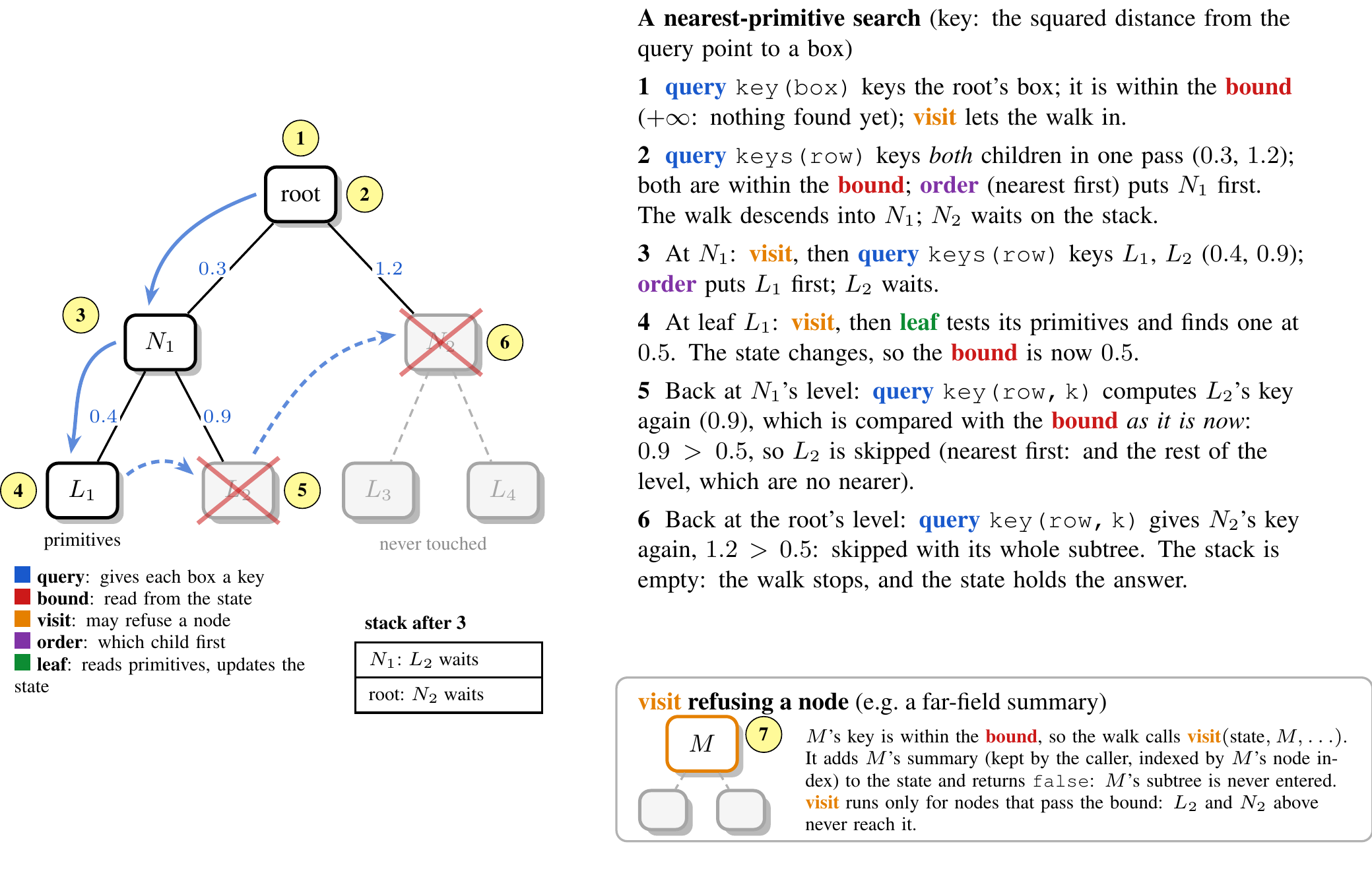
Fig. 19 A nearest-primitive search walking a small tree (K = 2). The numbered events are where the walk
calls the pieces the search supplies, colored by piece: the query keys the root with key(box)
and both children of a node in one pass with keys(row) (1–3), the order puts the nearer child
first, the leaf callback finds a primitive and so tightens the bound (4), and on the way back the
query’s key(row, k) recomputes each waiting child’s key for the bound as it is then, which
prunes L2 and the whole subtree under N2 (5–6). The panel below shows visit refusing a
node that passed the bound, after adding the caller’s summary of its subtree to the state (7).
Three things follow from this shape:
The bound is read again at every node. A leaf you visit early tightens the pruning of every node after it, in any part of the tree – which is why visiting the most promising child first pays off.
The state is yours. The walk only passes it to your callbacks; only
leaf(andvisit, if you give one) change it, andboundreads it.Keys are compared, never stored. A child that waits on the stack gets its key again when the walk comes back to it, so the comparison sees the bound as it is then.
The pieces you supply
Piece |
Signature |
Called |
What it is for |
|---|---|---|---|
|
a query type ( |
at every interior node (all |
what is tracked through the tree: it gives each box a key, how far the box is from the query |
|
any type, passed by reference |
– |
what the search remembers between leaves: the best value so far, the best primitive, a list of hits |
|
|
once per leaf reached |
test the leaf’s primitives, |
|
|
at every node expanded and every child resumed |
how far a box may be and still be entered: a box whose key is above it is skipped with its whole subtree |
|
|
for every node about to be entered (root, interior, leaf), after the bound check |
decide on the node itself: return |
|
|
when a node’s kept children are sorted |
which child to visit first. |
The rules your pieces follow:
They are template parameters – lambdas or functors, not
std::function– so the same call runs in a kernel. On a device, write them as functors withEBGEOMETRY_HOST_DEVICEcall operators, or as lambdas inside such a function.traverse()isnoexcept: an exception from a callback ends the program.Under
NearestFirstthe bound may only tighten during a walk (never grow), since the walk drops the rest of a level once one child is out of it. Every search that narrows in on a best answer does this naturally. A search whose bound can grow should pick another order.To stop the walk, make
boundreturn \(-\infty\) (below every key): an any-hit search does this after its first hit.A key of \(+\infty\) is never entered, whatever the bound: a ray query gives it to a box the ray misses. A bound of \(+\infty\) therefore means “no bound yet”, and a ray search can start there.
Query types
BVH::PointQuery{p}– the key of a box is the squared distance frompto it (0 inside it). The bound is a squared distance too. In a function that also runs on a device, write the precision out,BVH::PointQuery<T>{p}: HIP’s compiler treats the deduction guide behindPointQuery{p}as a host function.BVH::RayQuery(origin, direction, tMin)– the key of a box is the distance along the ray (unit direction) at which it enters the box, fromtMinon, or \(+\infty\) if it misses it. A segment fromatobis the ray fromatowardbwith the bound starting at|b - a|.Your own query type – anything with
using Scalar = T;keys(row)returning theKchildren’s keys from the node’s row of child boxes (BVH::ChildBoxes:m_lo[axis][child],m_hi[axis][child], laid out for SIMD);key(row, k)returning one child’s key, bit for bit whatkeys()gave; andkey(box)for the root. It may declareusing Key = ...for a key that is not a number, such as a distance with a tie-break (it needs<=,>and, for the nearest/farthest orders,<).
Recipes
The nearest primitive to a point (what the mesh SDFs and point clouds do):
struct Best { T d2 = inf; uint32_t id = none; };
Best best;

bvh.traverse(BVH::PointQuery<T>{p}, best,
             [&](Best& b, size_t offset, size_t count) {          // distance to each primitive
               for (size_t i = offset; i < offset + count; i++) {
                 const T d2 = distance2(prims[i], p);
                 if (d2 < b.d2) { b = Best{d2, uint32_t(i)}; }
               }
             },
             [](const Best& b) { return b.d2; });                 // farther boxes cannot do better
The first primitive a ray hits: the same, with a RayQuery, a ray–primitive test in leaf and the
nearest hit so far as the bound. Whether anything is hit (a shadow ray, a blocked segment): keep a flag,
return \(-\infty\) from bound once it is set, and use AsStored, since any hit will do:
bool hit = false;

bvh.traverse(BVH::RayQuery<T>(a, direction), hit,
             [&](bool& h, size_t offset, size_t count) { /* h = h || any primitive hit before |b - a| */ },
             [&](const bool& h) { return h ? -inf : length; },
             BVH::DescendAll{}, BVH::AsStored{});
Everything within a radius r of a point: collect in leaf, return r * r from bound (it
never changes), and use AsStored. A far-field approximation: in visit, when a node is far enough
for its summary (kept in your own array, indexed by nodeIndex), add the summary to the state and
return false; otherwise return true and let the walk descend.
The BVHTraversal example runs the first three in full, on the host and on a device. For the exact signatures, see the Doxygen reference for PackedBVH and the BVH namespace.
SIMD and the same answers everywhere. PointQuery computes the K squared distances in a
single SIMD batch where the (K, T) pair has a compiled path (see SIMD-accelerated classes), and
with a scalar loop otherwise, which is also what device code runs; RayQuery does the same for its
slab test. The paths agree bit for bit, so a query answered on a build with no SIMD returns what the
same query returns on an AVX-512 build or on a device. The one exception is a compiler that contracts
a multiply and an add into a fused multiply-add (GCC and nvcc by default, Clang within one expression,
wherever the hardware has FMA; on the host, e.g. with -march=native): PointQuery’s paths can
then differ in the last bit, and so can whether a ray that grazes a box’s edge within rounding enters
it. That changes only which boxes a ray query visits, never its answer, and RayQuery’s entry
distances still agree bit for bit. RayQuery is robust at the edges: a ray that meets a box only
along an edge or at a corner enters it, a ray through a face or edge shared by two boxes enters at least
one of them, and a ray lying in a box’s face plane is not counted as missing it.
The traversal stack
The stack is a fixed-size array, with one entry per level of the tree, so the traversal allocates
nothing and runs unchanged on a device. That bounds the depth of a tree it can walk: 256 levels on
the host (BVH::HostTraversalDepth) and 32 on a device (BVH::DeviceTraversalDepth, smaller since
device stack memory is per thread), at every K.
No input makes the library’s builds too deep for either: the static builds, TreeBVH::pack() and the
point and sphere clouds keep every tree within the device depth, so any of them can be traversed on a
device, even for points that crowd ever closer together. A node array adopted from elsewhere is taken
as it is: it is checked against the host depth when it is adopted, and every device view against the device
depth when rebasedView() makes it, in every build. A tree too deep aborts with a message giving its
depth, rather than overflowing the stack, which in Release would be a silent out-of-bounds write.
Splitting the bound from the leaf callback like this is what lets very different searches share one
walk: a nearest-neighbor search over a point cloud tracks a plain running squared distance as its state
(no abs(), no square root in the hot path) with a bound that returns the state unchanged, whereas
MeshSDF::signedDistance() (see Mesh distance functions) tracks a signed distance and squares its
magnitude for the bound (TriMeshSDF tracks a squared unsigned distance on the host and signs the
winner at the end), and a closest-hit ray search tracks the nearest crossing – all
ordinary calls of the same traverse() with a PointQuery or a RayQuery, not special cases
in PackedBVH. The first needs nothing more than a bare point struct with no signedDistance()
member at all.