Shell extraction
A thin wall around a mesh’s surface; here Lucy, rotated upright, with a quarter cut away. The source is
at Examples/Shell/main.cpp.
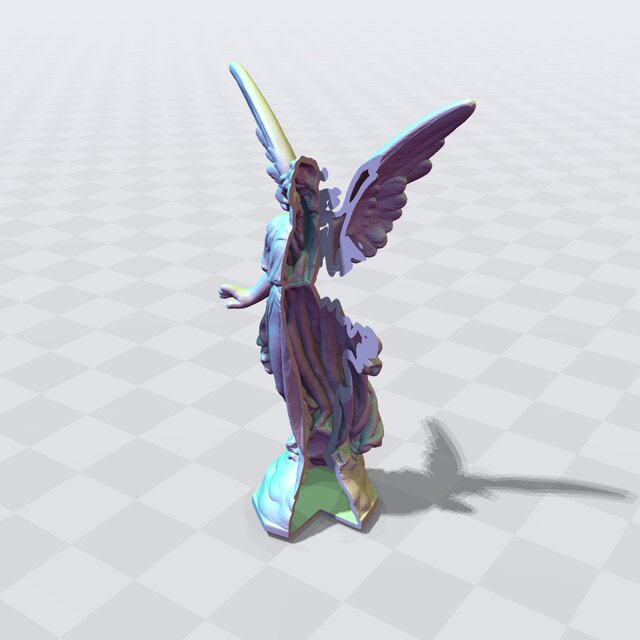
Fig. 26 Lucy hollowed into a shell, a quarter cut away.
Important
The default mesh comes from the common-3d-test-models git submodule. Clone with
--recurse-submodules, or run git submodule update --init in the repository (see
Obtaining EBGeometry); otherwise pass a mesh of your own as the first argument.
Placing the mesh
Lucy stands along \(z\) in the file. Rotate turns her about \(x\) so that she stands along
\(y\) and about \(y\) so that she faces the camera; Scale and Translate then give her height
2 and stand her on \(y = 0\).
Hollowing it
Annular(e, d) keeps the points within \(d\) of the surface (see
Value operations): a wall \(2d\) thick centered on it, the kind of thin wall an
embedded-boundary grid often needs from a closed surface mesh. A Difference with a box removes the
quarter towards the camera:
using Tape = EBGeometry::Tape<T, EBGeometry::TapeFeature::ExactOffsets>;

const Tape shell(pool, Difference(Annular(statue, T(0.5) * thickness), quarter));
The tape type lists TapeFeature::ExactOffsets, so that rays trace the shell exactly (see below). A tape
compiles such an optional feature only when its type lists it (see Tape features), so tapes that do
not need it are not slowed by it.
The program prints the solid’s and the shell’s values at two points inside the statue: negative in the solid, positive in the shell, whose inside is now hollow.
Looking at it
The example ends with Render::view(shell, pool, argc, argv), a window on the shell with its quarter cut
away. Its rays trace the shell exactly, from the mesh’s faces offset by the wall’s half-thickness, rather than
marching its value (see Rays and segments); this holds through the Scale, Translate and Rotate
that placed the mesh.
The window needs SDL2 and is built with make VIEWER=SDL2 or cmake -DEBGEOMETRY_VIEWER=SDL2 (see
The viewer window (EBGEOMETRY_VIEWER)); otherwise, and with --no-view or without a display, view() prints why
and returns. Drag to orbit and scroll to zoom; the window lists its other keys (see
The viewer’s keys).
Building and running
See Building for how to compile it with CMake, GNU Make, or a direct compiler invocation. Built for a GPU (see Running on a GPU), the window renders on the device.
cd Examples/Shell
./Shell.ex