MeshClosestPoint
Finds the point of a mesh closest to a few query points, and the gradient of the signed distance from it,
on the host and through GPU::transform. The source is at Examples/MeshClosestPoint/main.cpp.
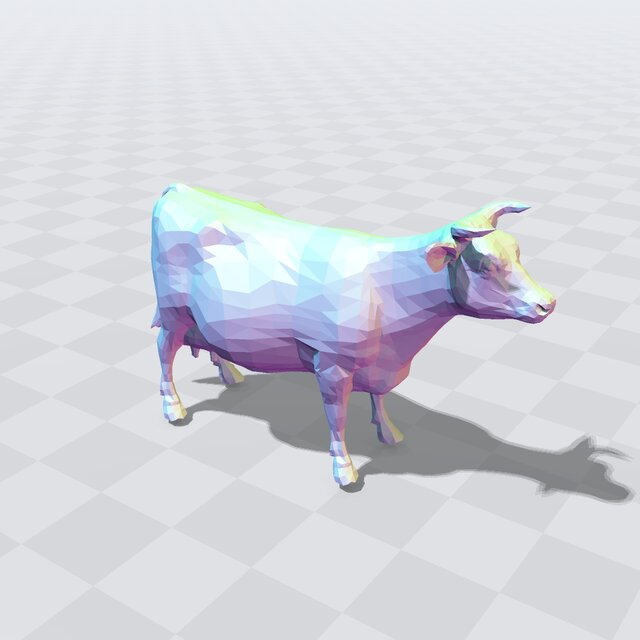
Fig. 31 The cow as the viewer first shows it.
The code that runs on either side
The query handed to GPU::transform holds a
TriMeshSDF by value and returns its gradient() at a
point, a Vec3T.
Read the mesh
The mesh comes from the command line or, by default, cow.obj from the common-3d-test-models
submodule (see Getting the code), read into a TriMeshSDF. FlatMeshSDF and MeshSDF have the same
two calls.
Use it on the host
For each point, closestPoint() returns a
ClosestPoint: the signed distance, the closest point,
the face it lies on and the pseudonormal there. gradient() returns the unit gradient of the distance,
computed from the closest point (see The closest point and the gradient). The program prints both, and shows that
\(\mathbf{x} - S(\mathbf{x})\,\nabla S(\mathbf{x})\) is the closest point: a point moves onto the surface in
one step. Beside it, the finite-difference normal() of the same function agrees to the accuracy its step
allows, from six distance queries instead of one. On the surface itself, the gradient is the pseudonormal of
the face, edge or vertex the point is on.
The same query on a GPU
The pool is frozen and mirrored to the device, and GPU::transform runs the gradient query there with a
view of the TriMeshSDF on the mirror. In a plain C++ build the same lines run as a host loop.
Look at it
Render::view(sdf, pool, argc, argv) opens the viewer on the mesh, if the example was built with it (see
The viewer).