Sphere clouds
Particles of differing sizes, kept as a center and a radius each in arrays of the program’s own: the signed
distance to their union, and the particle closest to a point, through a
SphereCloudBVH (see Point clouds). The
source is at Examples/SphereClouds/main.cpp.
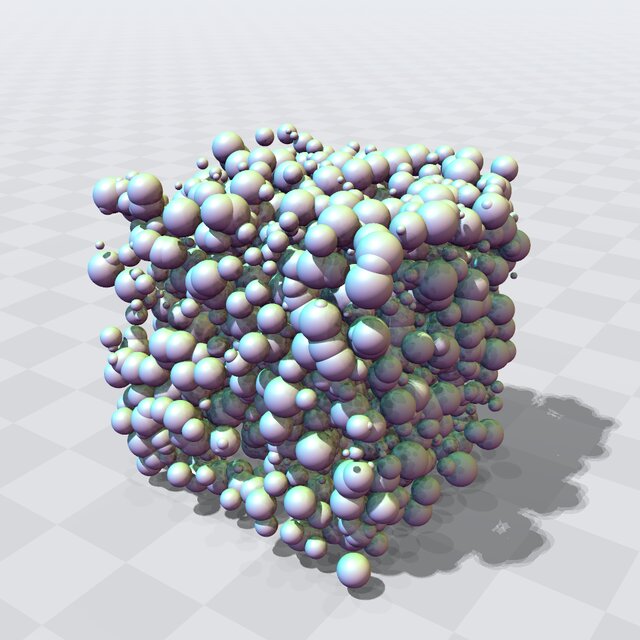
Fig. 33 2,000 particles in the unit cube, with radii between 0.01 and 0.06.
The code that runs on either side
The query functor ClosestParticle holds the cloud by value and maps a point to the closest particle, through
an EBGEOMETRY_HOST_DEVICE call operator. A cloud owns no memory – it describes the spheres and the BVH in a
Pool – so it is trivially copyable, and a kernel can receive it by value once it describes memory the device
can read.
Building the cloud
The cloud is built from the program’s arrays of centers and radii (or from one array of
SphereCloud::Sphere), and keeps its own copy in the pool, which must outlive it:
EBGeometry::Pool pool(EBGeometry::hostMemoryResource());

const SphereCloudBVH<T> cloud(pool, centers, radii);
A query reports a particle by its index in those arrays, so data the cloud does not hold (here a material per particle) stays in the program’s own arrays, indexed the same way.
Using it on the host
signedDistance(p) is the smallest \(|p - c| - r\) over the particles: negative inside a particle, and the
distance to the nearest one outside them all. closestSphere(p) names that particle and gives the same
distance. The program prints both at a few points, and the value at a particle’s center.
The same query on a GPU
The pool is frozen and mirrored into GPU::memoryResource(), and rebasedView() gives a cloud that reads the
copy; GPU::transform() runs ClosestParticle once per point in a kernel. In a plain C++ build the same lines
run on the host.
Looking at it
The example ends with Render::view(cloud, pool, argc, argv); X cuts the cloud open.
The window needs SDL2 and is built with make VIEWER=SDL2 or cmake -DEBGEOMETRY_VIEWER=SDL2 (see
The viewer window (EBGEOMETRY_VIEWER)); otherwise, and with --no-view or without a display, view() prints why
and returns. Drag to orbit and scroll to zoom; the window lists its other keys (see
The viewer’s keys).
Building and running
See Building for how to compile it with CMake, GNU Make, or a direct compiler invocation. Built for a GPU (see Running on a GPU), the queries and the window run on the device.
cd Examples/SphereClouds
./SphereClouds.ex