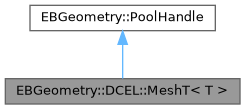
DCEL mesh class - stores a doubly-connected edge mesh. More...
#include <EBGeometry_DCEL_Mesh.hpp>

Classes | |
| struct | Layout |
| The mesh's arrays as offsets into its pool, with no location: what another pool-resident object stores when it holds this mesh (see PoolHandle). More... | |
Public Types | |
| enum class | SearchAlgorithm { Direct , Direct2 } |
| Possible search algorithms for DCEL::MeshT. More... | |
| using | Vec3 = Vec3T< T > |
| Alias for vector type. | |
| using | Vertex = VertexT< T > |
| Alias for vertex type. | |
| using | Edge = EdgeT< T > |
| Alias for edge type. | |
| using | Face = FaceT< T > |
| Alias for face type. | |
| using | Mesh = MeshT< T > |
| Alias for mesh type. | |
Public Member Functions | |
| MeshT () noexcept=default | |
| Default constructor. Leaves the mesh empty (no vertices, edges, faces) and attached to no Pool, so it cannot yet resolve anything. | |
| MeshT (const Layout &a_layout, const PoolLocation &a_location) noexcept | |
| Rebuild a handle from a stored layout and the location of the pool that holds it. | |
| Layout | layout () const noexcept |
| The mesh's arrays without its location, for storing it inside another pool-resident object. | |
| MeshT (const Mesh &a_otherMesh) noexcept=default | |
| Copy constructor. | |
| MeshT (Mesh &&a_otherMesh) noexcept=default | |
| Move constructor. | |
| ~MeshT () noexcept=default | |
| Destructor (does nothing; MeshT owns no resources). | |
| Mesh & | operator= (const Mesh &a_otherMesh) noexcept=default |
| Copy assignment operator. | |
| Mesh & | operator= (Mesh &&a_otherMesh) noexcept=default |
| Move assignment operator. | |
| Mesh | deepCopy (Pool &a_dstPool) const |
| Create an independent, fully-decoupled copy of this mesh's data in another Pool. | |
| void | sanityCheck (const std::string a_id) const |
| Perform a sanity check. | |
| void | setSearchAlgorithm (const SearchAlgorithm a_algorithm) noexcept |
| Search algorithm for direct signed distance computations. | |
| void | setInsideOutsideAlgorithm (InsideOutsideAlgorithm a_algorithm) noexcept |
| Set the inside/outside algorithm to use when computing the signed distance to polygon faces. | |
| void | reconcile () |
| Reconcile function which computes the internal parameters in vertices, edges, and faces for use with signed distance functionality. | |
| void | flip () noexcept |
| Flip the mesh, making all the normals change direction. | |
| void | reserveVertices (Pool &a_pool, uint32_t a_capacity) |
| Reserve storage for a_capacity vertices. | |
| void | reserveEdges (Pool &a_pool, uint32_t a_capacity) |
| Reserve storage for a_capacity half-edges. | |
| void | reserveFaces (Pool &a_pool, uint32_t a_capacity) |
| Reserve storage for a_capacity faces. | |
| uint32_t | addVertex (Pool &a_pool, const Vertex &a_vertex) |
| Append a vertex into the pre-reserved capacity (see reserveVertices()). | |
| uint32_t | addEdge (Pool &a_pool, const Edge &a_edge) |
| Append a half-edge into the pre-reserved capacity (see reserveEdges()). | |
| uint32_t | addFace (Pool &a_pool, const Face &a_face) |
| Append a face into the pre-reserved capacity (see reserveFaces()). | |
| Vertex & | getVertex (uint32_t a_index) noexcept |
| Get modifiable vertex by index. | |
| const Vertex & | getVertex (uint32_t a_index) const noexcept |
| Get immutable vertex by index. | |
| Edge & | getEdge (uint32_t a_index) noexcept |
| Get modifiable half-edge by index. | |
| const Edge & | getEdge (uint32_t a_index) const noexcept |
| Get immutable half-edge by index. | |
| Face & | getFace (uint32_t a_index) noexcept |
| Get modifiable face by index. | |
| const Face & | getFace (uint32_t a_index) const noexcept |
| Get immutable face by index. | |
| uint32_t | numVertices () const noexcept |
| Number of vertices in this mesh. | |
| uint32_t | numEdges () const noexcept |
| Number of half-edges in this mesh. | |
| uint32_t | numFaces () const noexcept |
| Number of faces in this mesh. | |
| std::vector< Vec3T< T > > | getAllVertexCoordinates () const |
| Return all vertex coordinates in the mesh. | |
| T | signedDistance (const Vec3 &a_x0) const noexcept |
| Compute the signed distance from a point to this mesh. | |
| T | signedDistance (const Vec3 &a_x0, SearchAlgorithm a_algorithm) const noexcept |
| Compute the signed distance from a point to this mesh, using an explicit search algorithm. | |
| T | unsignedDistance2 (const Vec3 &a_x0) const noexcept |
| Compute the unsigned square distance from a point to this mesh. | |
| Mesh | rebasedView (const Pool &a_pool) const noexcept |
| Produce a copy of this mesh's descriptor that resolves against a mirror of this mesh's Pool, rather than against the Pool the mesh was built in. | |
 Public Member Functions inherited from EBGeometry::PoolHandle | |
| PoolLocation | location () const noexcept |
| Where this handle's arrays live. | |
| bool | isAttachedTo (const Pool &a_pool) const noexcept |
Check whether this handle's arrays were reserved from a_pool. | |
Protected Member Functions | |
| void | attachTo (const Pool &a_pool) noexcept |
| Attach this mesh to a_pool, or check that it is already attached to it. | |
| void | reconcileFaces () noexcept |
| Function which computes internal things for the polygon faces. | |
| void | reconcileEdges () noexcept |
| Function which computes internal things for the half-edges. | |
| void | reconcileVertices () |
| Compute each vertex's angle-weighted pseudonormal. | |
| void | flipFaceNormals () noexcept |
| Flip all face normals. | |
| void | flipEdgeNormals () noexcept |
| Flip all edge normals. | |
| void | flipVertexNormals () noexcept |
| Flip all vertex normals. | |
| T | DirectSignedDistance (const Vec3 &a_point) const noexcept |
| Implementation of signed distance function which iterates through all faces. | |
| T | DirectSignedDistance2 (const Vec3 &a_point) const noexcept |
| Implementation of signed distance function which iterates through all faces, comparing squared unsigned distances. | |
| void | incrementWarning (std::map< std::string, size_t > &a_warnings, const std::string &a_warn) const |
| Increment a warning. This is used in sanityCheck() for locating holes or bad inputs in the mesh. | |
| void | printWarnings (const std::map< std::string, size_t > &a_warnings, const std::string &a_id) const |
| Print all warnings to std::cerr. | |
| bool | faceLoopCloses (uint32_t a_faceIndex, uint32_t &a_lastEdge, uint32_t &a_steps) const noexcept |
| Walk a face's half-edge loop, bounded by the number of half-edges. | |
| Protected Member Functions inherited from EBGeometry::PoolHandle | |
| PoolHandle () noexcept=default | |
| An unset location; the first reservation attaches it. | |
| PoolHandle (const PoolLocation &a_location) noexcept | |
| Adopt a location, as a handle rebuilt from a stored layout does. | |
| PoolHandle (const PoolHandle &) noexcept=default | |
| Copy a handle, as a derived handle's copy does. | |
| PoolHandle (PoolHandle &&) noexcept=default | |
| Move a handle; the same as a copy. | |
| PoolHandle & | operator= (const PoolHandle &) noexcept=default |
| Copy-assign a handle, as a derived handle's assignment does. | |
| PoolHandle & | operator= (PoolHandle &&) noexcept=default |
| Move-assign a handle; the same as a copy. | |
| ~PoolHandle () noexcept=default | |
| Destructor; protected, since a PoolHandle exists only as the base of a handle. | |
| void * | base () noexcept |
| The base address this handle's offsets resolve against; see PoolLocation::base(). | |
| const void * | base () const noexcept |
| The base address this handle's offsets resolve against, for read-only access. | |
| void | attach (const Pool &a_pool, const char *a_who) noexcept |
Follow a_pool, as the first reservation does; see PoolLocation::attach(). | |
| PoolLocation | rebasedLocation (const Pool &a_pool, uint64_t a_endByte, const char *a_who) const noexcept |
| The location of this handle's arrays in another pool of its mirror chain; see PoolLocation::rebasedOnto(). | |
| void | setLocation (const PoolLocation &a_location) noexcept |
| Replace the location, for a view or a copy made by a derived handle. | |
Protected Attributes | |
| SearchAlgorithm | m_algorithm = SearchAlgorithm::Direct2 |
| Search algorithm. Only used in signed distance functions. | |
| PODVector< Vertex > | m_vertices |
| Mesh vertices. | |
| PODVector< Edge > | m_edges |
| Mesh half-edges. | |
| PODVector< Face > | m_faces |
| Mesh faces. | |
Detailed Description
class EBGeometry::DCEL::MeshT< T >
DCEL mesh class - stores a doubly-connected edge mesh.
Mesh class which stores a full DCEL mesh (with signed distance functions)
- Template Parameters
-
T Floating-point precision type.
This encapsulates a full DCEL mesh, and also includes DIRECT signed distance functions. The mesh consists of a set of vertices, half-edges, and polygon faces, stored as PODVectors; every cross-reference between them (vertex-to-outgoing-edge, edge-to-vertex/pair edge/next edge/face, face-to-half-edge) is an index into these arrays rather than a pointer – see the class-level notes on VertexT/EdgeT/FaceT. The signed distance functions DIRECT, which means that they go through ALL of the polygon faces and compute the signed distance to them. This is extremely inefficient, which is why this class is almost always embedded into a bounding volume hierarchy.
- Note
- MeshT owns no resources: every member (three PODVectors, the search-algorithm enum, and the PoolLocation held by its PoolHandle base) is a plain value, so MeshT is trivially copyable – a bytewise copy is meaningful in any address space, since it never needs to dereference anything beyond its own bytes. This is what makes a mesh built and reconciled on the host mirror-safe: its Pool can be mirrored to a device and the mesh rebased onto the mirror (see rebasedView()), with zero pointer patching inside the mesh itself.
A mesh resolves its PODVector offsets through its PoolLocation (see PoolHandle and PoolLocation::base()), which takes one of two forms:
- it follows the control block of the Pool the mesh was reserved from, from the first reserveVertices/Edges/Faces() call on. Because the base is re-read from the control block on every access, a mesh is queryable at any point during the build, including across a Pool::reserve that grows and moves the block – there is no freeze, and nothing to re-bind.
- it holds a snapshot of a plain base address, made only by rebasedView() and only for a device-accessible target, since a kernel cannot follow a control block. Host code may use the snapshot only if that memory is host-accessible (Managed, Mapped). A location that still follows a control block on a device means a host descriptor was copied into a kernel without rebasedView(), which EBGEOMETRY_EXPECT catches.
- Warning
- A reference returned by getVertex()/getEdge()/getFace() is a raw address resolved at the moment of the call, and Pool::reserve may deallocate the block it points into (see the warning on Pool::reserve). Resolve, use, discard: to carry an element across a reserve, copy it by value and write it back through a fresh accessor call.
- Note
- Everything that resolves purely through base(), the PODVectors, and VertexT/EdgeT/FaceT methods that are themselves EBGEOMETRY_HOST_DEVICE (getVertex/getEdge/getFace, numVertices/ numEdges/numFaces, setSearchAlgorithm, setInsideOutsideAlgorithm, reconcileEdges, flipFaceNormals/flipEdgeNormals/flipVertexNormals, flip, DirectSignedDistance/ DirectSignedDistance2, every signedDistance overload, unsignedDistance2) is annotated EBGEOMETRY_HOST_DEVICE – signedDistance's algorithm-selecting switch deliberately relies on EBGEOMETRY_EXPECT() alone (not std::cerr) to flag a corrupted SearchAlgorithm, specifically so it stays device-callable; see the implementation. The rest stays EBGEOMETRY_HOST because it touches a Pool directly (rebasedView, deepCopy, reserveVertices/Edges/Faces, addVertex/Edge/Face), returns a host container (getAllVertexCoordinates), logs diagnostics to std::cerr (sanityCheck and its incrementWarning/printWarnings helpers), or delegates to a VertexT/EdgeT/FaceT method that itself allocates a std::vector or can log a diagnostic the same way (reconcileFaces calls FaceT::reconcile; reconcileVertices builds a transient per-vertex face list and aborts with a message on a face that visits a vertex twice) – reconcile/reconcileFaces/reconcileVertices therefore remain EBGEOMETRY_HOST.
- Template Parameters
-
T Floating-point precision type.
Member Enumeration Documentation
◆ SearchAlgorithm
|
strong |
Possible search algorithms for DCEL::MeshT.
| Enumerator | |
|---|---|
| Direct | Computes the signed distance to every face and returns the one with the smallest magnitude. See DirectSignedDistance(). |
| Direct2 | Computes the squared unsigned distance to every face to find the closest one, then returns the signed distance to only that face. Equivalent to Direct but usually faster since it avoids a square root per face. See DirectSignedDistance2(). |
Constructor & Destructor Documentation
◆ MeshT() [1/4]
|
defaultnoexcept |
Default constructor. Leaves the mesh empty (no vertices, edges, faces) and attached to no Pool, so it cannot yet resolve anything.
No Pool is needed at construction – every build-phase method (reserveX/addX) takes its Pool explicitly. Use reserveVertices()/reserveEdges()/reserveFaces() followed by addVertex()/addEdge()/addFace() to populate the mesh (a file parser normally does this); the first reserve attaches the mesh to that Pool, after which it is queryable immediately – there is no separate binding or freezing step.
◆ MeshT() [2/4]
|
inlinenoexcept |
Rebuild a handle from a stored layout and the location of the pool that holds it.
How an outer pool-resident object evaluates a mesh it stores as a layout: it pairs the layout with its own location. a_location must belong to the pool the layout was reserved from, or to a mirror of it; nothing is checked, since a device has no pool to check against.
- Parameters
-
[in] a_layout The mesh's arrays. [in] a_location Where they live.
◆ MeshT() [3/4]
|
defaultnoexcept |
Copy constructor.
Defaulted memberwise copy. Every member is a plain value (three PODVectors, the search-algorithm enum, and the PoolLocation held by the PoolHandle base), so this is a cheap, always-safe descriptor copy – it does NOT duplicate the underlying vertex/edge/face data, which stays shared between the original and the copy (both still resolve against the same Pool/base). Use deepCopy() when independent, separately-owned storage is required (e.g. in a different Pool).
- Parameters
-
[in] a_otherMesh Other mesh.
◆ MeshT() [4/4]
|
defaultnoexcept |
Move constructor.
Defaulted memberwise move. Since every member is a plain value, this is identical to the copy constructor – the moved-from mesh is left referencing the exact same data (not emptied), since MeshT never owned that data in the first place.
- Parameters
-
[in,out] a_otherMesh Other mesh.
Member Function Documentation
◆ addEdge()
|
inline |
Append a half-edge into the pre-reserved capacity (see reserveEdges()).
- Parameters
-
[in,out] a_pool Pool this mesh's half-edges were reserved from. [in] a_edge Half-edge to append.
- Returns
- Index of the newly-appended half-edge in this mesh's edge array.
◆ addFace()
|
inline |
Append a face into the pre-reserved capacity (see reserveFaces()).
- Parameters
-
[in,out] a_pool Pool this mesh's faces were reserved from. [in] a_face Face to append.
- Returns
- Index of the newly-appended face in this mesh's face array.
◆ addVertex()
|
inline |
Append a vertex into the pre-reserved capacity (see reserveVertices()).
- Parameters
-
[in,out] a_pool Pool this mesh's vertices were reserved from. [in] a_vertex Vertex to append.
- Returns
- Index of the newly-appended vertex in this mesh's vertex array.
◆ attachTo()
|
inlineprotectednoexcept |
◆ deepCopy()
|
inline |
Create an independent, fully-decoupled copy of this mesh's data in another Pool.
Reserves fresh storage in a_dstPool and copies every vertex/edge/face by value; since every cross-reference is an index rather than a pointer, the copy is already fully independent and correctly linked – no relinking pass is needed. Every field is preserved exactly (position, normal vector, centroid, area, search algorithm) rather than recomputed, so a mesh that has had flipNormal()/flip() called on it and not yet been re-reconciled is copied faithfully rather than silently "un-flipped". Unlike the copy/move constructors, this creates genuinely separate storage rather than sharing the source's, and the returned mesh is attached to a_dstPool.
- Note
- a_dstPool may be the same Pool this mesh's data already lives in. That is safe even though the reserves below can grow (and move) the block, because both meshes re-resolve through the Pool's control block on every access rather than caching an address.
- Parameters
-
[in,out] a_dstPool Pool to reserve the copy's storage from.
- Returns
- A new mesh, independent of this one, by value.
◆ DirectSignedDistance()
|
inlineprotectednoexcept |
Implementation of signed distance function which iterates through all faces.
- Parameters
-
[in] a_point 3D point
- Returns
- Signed distance to the nearest face, or +infinity if the mesh has no faces.
◆ DirectSignedDistance2()
|
inlineprotectednoexcept |
Implementation of signed distance function which iterates through all faces, comparing squared unsigned distances.
This first finds the face with the smallest unsigned squared distance, and then returns the signed distance to that face (more efficient than the other version).
- Parameters
-
[in] a_point 3D point
- Returns
- Signed distance to the nearest face, or +infinity if the mesh has no faces.
◆ faceLoopCloses()
|
inlineprotectednoexcept |
Walk a face's half-edge loop, bounded by the number of half-edges.
EdgeIteratorT does not count its steps, so it would never finish on a loop that cycles without returning to its first edge, and it reads out of bounds at an edge index past the end of the edge array. This walk stops on both. reconcile() aborts on such a loop and sanityCheck() reports it.
- Parameters
-
[in] a_faceIndex Face whose loop to walk. [out] a_lastEdge The edge index the walk stopped at (the face's first edge if the loop closes). [out] a_steps The number of steps taken.
- Returns
- True if the loop returns to the face's first edge.
◆ flip()
|
inlinenoexcept |
Flip the mesh, making all the normals change direction.
- Note
- Should be called AFTER all normals have been computed.
◆ getAllVertexCoordinates()
|
inline |
Return all vertex coordinates in the mesh.
- Returns
- Vector of 3D coordinates of all vertices.
◆ getEdge() [1/2]
|
inlinenoexcept |
Get immutable half-edge by index.
- Warning
- The returned reference is invalidated by any Pool::reserve on this mesh's Pool; see the class-level warning.
- Parameters
-
[in] a_index Half-edge index (must be < numEdges()).
- Returns
- Const reference to the half-edge.
◆ getEdge() [2/2]
|
inlinenoexcept |
Get modifiable half-edge by index.
- Warning
- The returned reference is invalidated by any Pool::reserve on this mesh's Pool; see the class-level warning.
- Parameters
-
[in] a_index Half-edge index (must be < numEdges()).
- Returns
- Reference to the half-edge.
◆ getFace() [1/2]
|
inlinenoexcept |
Get immutable face by index.
- Warning
- The returned reference is invalidated by any Pool::reserve on this mesh's Pool; see the class-level warning.
- Parameters
-
[in] a_index Face index (must be < numFaces()).
- Returns
- Const reference to the face.
◆ getFace() [2/2]
|
inlinenoexcept |
Get modifiable face by index.
- Warning
- The returned reference is invalidated by any Pool::reserve on this mesh's Pool; see the class-level warning.
- Parameters
-
[in] a_index Face index (must be < numFaces()).
- Returns
- Reference to the face.
◆ getVertex() [1/2]
|
inlinenoexcept |
Get immutable vertex by index.
- Warning
- The returned reference is invalidated by any Pool::reserve on this mesh's Pool; see the class-level warning.
- Parameters
-
[in] a_index Vertex index (must be < numVertices()).
- Returns
- Const reference to the vertex.
◆ getVertex() [2/2]
|
inlinenoexcept |
Get modifiable vertex by index.
- Warning
- The returned reference is invalidated by any Pool::reserve on this mesh's Pool; see the class-level warning.
- Parameters
-
[in] a_index Vertex index (must be < numVertices()).
- Returns
- Reference to the vertex.
◆ incrementWarning()
|
inlineprotected |
Increment a warning. This is used in sanityCheck() for locating holes or bad inputs in the mesh.
- Parameters
-
[in] a_warnings Map of all registered warnings [in] a_warn Current warning to increment by
◆ layout()
|
inlinenoexcept |
The mesh's arrays without its location, for storing it inside another pool-resident object.
- Returns
- The layout.
◆ numEdges()
|
inlinenoexcept |
Number of half-edges in this mesh.
- Returns
- Half-edge count.
◆ numFaces()
|
inlinenoexcept |
Number of faces in this mesh.
- Returns
- Face count.
◆ numVertices()
|
inlinenoexcept |
Number of vertices in this mesh.
- Returns
- Vertex count.
◆ operator=() [1/2]
|
defaultnoexcept |
Copy assignment operator.
Has the same semantics as the copy constructor; see its documentation.
- Parameters
-
[in] a_otherMesh Other mesh.
- Returns
- Reference to (*this).
◆ operator=() [2/2]
|
defaultnoexcept |
Move assignment operator.
Has the same semantics as the move constructor; see its documentation.
- Parameters
-
[in,out] a_otherMesh Other mesh.
- Returns
- Reference to (*this).
◆ printWarnings()
|
inlineprotected |
Print all warnings to std::cerr.
- Parameters
-
[in] a_warnings List of warnings (generated by sanityCheck) [in] a_id Identifier used when printing warnings (can be empty string)
◆ rebasedView()
|
inlinenoexcept |
Produce a copy of this mesh's descriptor that resolves against a mirror of this mesh's Pool, rather than against the Pool the mesh was built in.
This is the one sanctioned way to move a mesh between address spaces. Only the descriptor is copied – the vertex/edge/face data is whatever a_pool already contains, which Pool::mirror put there. Since every cross-reference is a byte offset rather than a pointer, no patching is needed on either side:
How the returned view resolves depends on a_pool, not on a separate choice by the caller (see PoolLocation::rebasedOnto()):
- a device-accessible target (Device, Managed, Mapped), which must be frozen, yields a view holding a plain base address, since a kernel cannot follow a host control block. The host can use the view too if the memory is host-accessible (Managed, Mapped), but not for a Device pool.
- a host-only target (Host, Pinned) yields a view holding that Pool's control block, so it is growth-immune exactly like the original mesh.
- Note
- a_pool must be the Pool this mesh was built in or belong to its mirror chain – a mirror of it, or a mirror of a mirror (so host -> pinned staging -> device works, including rebasing a view of the staging pool onto the device pool). It must also be large enough to contain this mesh's arrays, which catches a Pool mirrored before the mesh's last reserve. Each is checked in every build; a violation aborts with a message.
- Returns
- A mesh descriptor resolving against a_pool.
◆ reconcile()
|
inline |
Reconcile function which computes the internal parameters in vertices, edges, and faces for use with signed distance functionality.
This will reconcile faces, edges, and vertices, e.g. computing the area and normal vector for faces, and the angle-weighted pseudonormal of each vertex (Baerentzen and Aanes, DOI: 10.1109/TVCG.2005.49). A malformed topology that would otherwise read out of bounds or never finish (a face whose half-edge loop does not return to its first edge, a face with fewer than 3 vertices, a vertex index past the end of the vertex array, or a face visiting a vertex more than once) aborts with a message in every build. A mesh assembled by hand must be reconciled before it is queried.
◆ reconcileEdges()
|
inlineprotectednoexcept |
Function which computes internal things for the half-edges.
- Note
- This calls DCEL::EdgeT<T>::reconcile()
◆ reconcileFaces()
|
inlineprotectednoexcept |
Function which computes internal things for the polygon faces.
- Note
- This calls DCEL::FaceT<T>::reconcile()
◆ reconcileVertices()
|
inlineprotected |
Compute each vertex's angle-weighted pseudonormal.
- Note
- This calls DCEL::VertexT<T>::computeVertexNormalAngleWeighted().
◆ reserveEdges()
|
inline |
Reserve storage for a_capacity half-edges.
Must be called before any addEdge() call, and only once – PODVector never reallocates once reserved (see EBGeometry_PODVector.hpp).
- Parameters
-
[in,out] a_pool Pool to reserve from (must not be frozen). [in] a_capacity Number of half-edge slots to reserve.
◆ reserveFaces()
|
inline |
Reserve storage for a_capacity faces.
Must be called before any addFace() call, and only once – PODVector never reallocates once reserved (see EBGeometry_PODVector.hpp).
- Parameters
-
[in,out] a_pool Pool to reserve from (must not be frozen). [in] a_capacity Number of face slots to reserve.
◆ reserveVertices()
|
inline |
Reserve storage for a_capacity vertices.
Must be called before any addVertex() call, and only once – PODVector never reallocates once reserved (see EBGeometry_PODVector.hpp).
- Parameters
-
[in,out] a_pool Pool to reserve from (must not be frozen). [in] a_capacity Number of vertex slots to reserve.
◆ sanityCheck()
|
inline |
Perform a sanity check.
This will provide error messages if vertices are badly linked, faces have no half-edge, and so on. These messages are logged by calling incrementWarning() which identifies types of errors that can occur, and how many of those errors have occurred. A face whose half-edge loop does not close is reported and skipped, so the check finishes on any mesh, reconciled or not.
- Parameters
-
[in] a_id Identifier when printing error messages (can be empty string).
◆ setInsideOutsideAlgorithm()
|
inlinenoexcept |
Set the inside/outside algorithm to use when computing the signed distance to polygon faces.
Computing the signed distance to faces requires testing if a point projected to a polygon face plane falls inside or outside the polygon face. There are multiple algorithms to use here.
- Parameters
-
[in] a_algorithm Algorithm to use
◆ setSearchAlgorithm()
|
inlinenoexcept |
Search algorithm for direct signed distance computations.
- Parameters
-
[in] a_algorithm Algorithm to use
◆ signedDistance() [1/2]
|
inlinenoexcept |
Compute the signed distance from a point to this mesh.
- Parameters
-
[in] a_x0 3D point in space.
This function will iterate through ALL faces in the mesh and return the value with the smallest magnitude. This is horrendously slow, which is why this function is almost never called. Rather, MeshT<T> can be embedded in a bounding volume hierarchy for faster access.
- Note
- This will call the other version with the object's search algorithm.
- Returns
- Signed distance to the mesh; negative inside, positive outside. Returns +infinity if the mesh has no faces.
◆ signedDistance() [2/2]
|
inlinenoexcept |
Compute the signed distance from a point to this mesh, using an explicit search algorithm.
- Parameters
-
[in] a_x0 3D point in space. [in] a_algorithm Search algorithm
This function will iterate through ALL faces in the mesh and return the value with the smallest magnitude. This is horrendously slow, which is why this function is almost never called. Rather, MeshT<T> can be embedded in a bounding volume hierarchy for faster access.
- Returns
- Signed distance to the mesh; negative inside, positive outside. Returns +infinity if the mesh has no faces.
◆ unsignedDistance2()
|
inlinenoexcept |
Compute the unsigned square distance from a point to this mesh.
- Parameters
-
[in] a_x0 3D point in space.
This function will iterate through ALL faces in the mesh and return the value with the smallest magnitude. This is horrendously slow, which is why this function is almost never called. Rather, MeshT<T> can be embedded in a bounding volume hierarchy for faster access.
- Returns
- Squared unsigned distance to the nearest face, or +infinity if the mesh has no faces.
The documentation for this class was generated from the following files:
- Source/EBGeometry_DCEL.hpp
- Source/EBGeometry_DCEL_Mesh.hpp
