Half-edge iterator class for navigating the half edge mesh. More...
#include <EBGeometry_DCEL_Iterator.hpp>
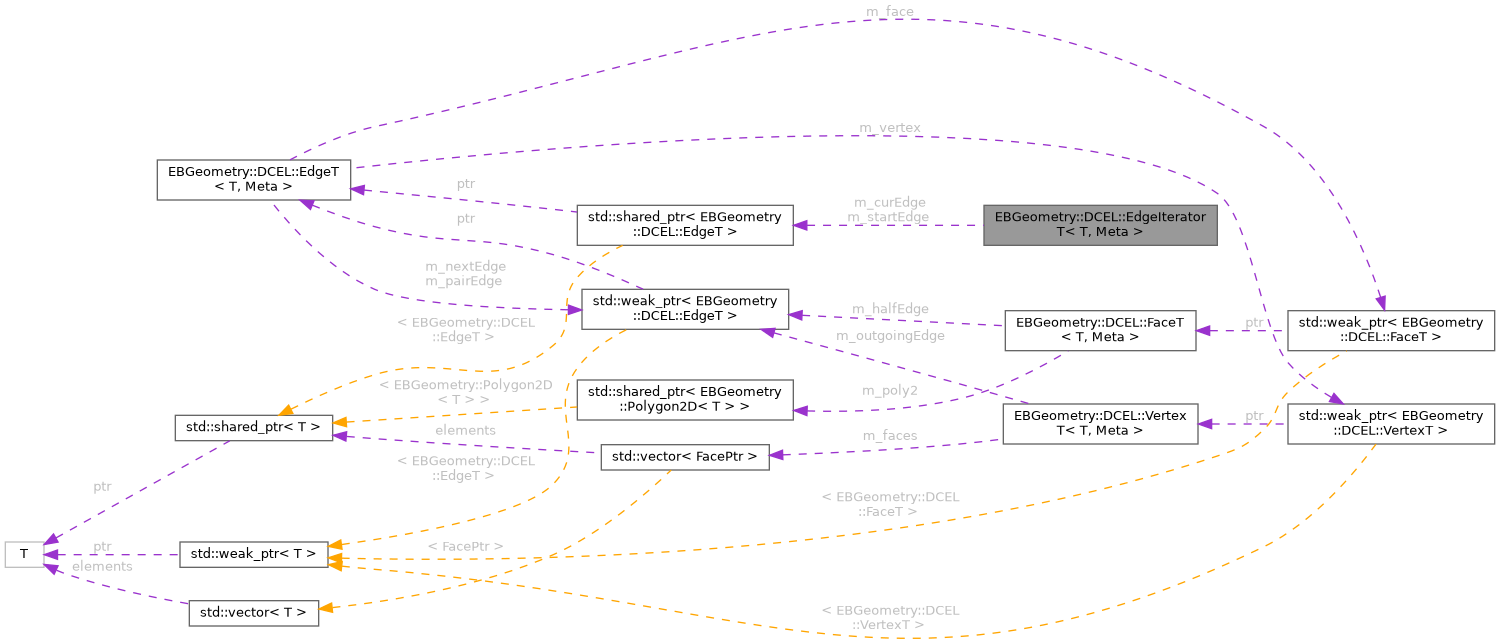
Public Types | |
| using | Vertex = VertexT< T > |
| Alias for DCEL vertex type. | |
| using | Edge = EdgeT< T > |
| Alias for DCEL edge type. | |
| using | Face = FaceT< T > |
| Alias for DCEL face type. | |
| using | Mesh = MeshT< T > |
| Alias for DCEL mesh type. | |
Public Member Functions | |
| EdgeIteratorT ()=delete | |
| Default construction is not allowed. Use one of the full constructors. | |
| EdgeIteratorT (const Mesh &a_mesh, const Face &a_face) noexcept | |
| Constructor, taking a mesh and a face as argument. The iterator begins at the half-edge index contained in the face. | |
| EdgeIteratorT (const Mesh &a_mesh, const uint32_t a_startEdgeIndex) noexcept | |
| Constructor, taking a mesh and an arbitrary starting half-edge index directly (rather than a face's own half-edge). Useful for iterating a half-edge loop when only an edge index – not its face – is available. | |
| EdgeIteratorT (const EdgeIteratorT &a_other) noexcept | |
| Copy constructor. | |
| EdgeIteratorT (EdgeIteratorT &&a_other) noexcept=default | |
| Move constructor. | |
| ~EdgeIteratorT () noexcept=default | |
| Destructor. | |
| EdgeIteratorT & | operator= (const EdgeIteratorT &a_other) noexcept=default |
| Copy assignment operator. | |
| EdgeIteratorT & | operator= (EdgeIteratorT &&a_other) noexcept=default |
| Move assignment operator. | |
| uint32_t | operator() () const noexcept |
| Operator returning the index of the current half-edge. | |
| void | reset () noexcept |
| Reset function for the iterator. This resets the iterator so that it begins from the starting half-edge. | |
| void | operator++ () noexcept |
| Incrementation operator, bringing the iterator to the next half-edge. | |
| bool | ok () const noexcept |
| Function which checks if the iteration can be continued. | |
Protected Attributes | |
| const Mesh * | m_mesh = nullptr |
| Owning mesh, used to resolve edge indices. Non-owning; must outlive the iterator. | |
| bool | m_fullLoop = false |
| If true, a full loop has been made around the polygon face. | |
| uint32_t | m_startEdge = UINT32_MAX |
| Starting half-edge index, or UINT32_MAX if unset. | |
| uint32_t | m_curEdge = UINT32_MAX |
| Current half-edge index, or UINT32_MAX if unset. | |
Detailed Description
class EBGeometry::DCEL::EdgeIteratorT< T >
Half-edge iterator class for navigating the half edge mesh.
Class which makes it easier to iterate through DCEL edges.
- Template Parameters
-
T Floating-point precision type.
Iterates the half-edge loop bounding a polygon face (or starting from an arbitrary half-edge index), following EdgeT::getNextEdgeIndex() until either the loop returns to its starting edge (a well-formed, closed face) or an unset next-edge index is reached (an incomplete/open half-edge chain). Resolves indices against the mesh passed at construction, so the iterator itself is a lightweight, short-lived (stack-only) helper – it must never be stored inside any DCEL object, a PODVector, or otherwise made to cross a host/device boundary as data (its m_mesh pointer is only ever meaningful within the address space it was constructed in). Typical usage:
- Note
- Every member resolves purely through m_mesh (itself resolved via EBGEOMETRY_HOST_DEVICE MeshT accessors) and plain uint32_t/bool values, so the entire public and protected interface is annotated EBGEOMETRY_HOST_DEVICE. Unlike every other DCEL class, this one is deliberately NOT std::is_trivially_copyable – see the copy constructor's doc comment – which is what stops it from being accepted into a PODVector in the first place.
- Template Parameters
-
T Floating-point precision type.
Constructor & Destructor Documentation
◆ EdgeIteratorT() [1/4]
|
noexcept |
Constructor, taking a mesh and a face as argument. The iterator begins at the half-edge index contained in the face.
- Parameters
-
[in] a_mesh Owning mesh, used to resolve edge indices. [in] a_face DCEL polygon face
- Note
- This constructor will iterate through the half-edges in the polygon face.
◆ EdgeIteratorT() [2/4]
|
noexcept |
Constructor, taking a mesh and an arbitrary starting half-edge index directly (rather than a face's own half-edge). Useful for iterating a half-edge loop when only an edge index – not its face – is available.
- Parameters
-
[in] a_mesh Owning mesh, used to resolve edge indices. [in] a_startEdgeIndex Starting half-edge index. May be UINT32_MAX (ok() will then immediately return false).
◆ EdgeIteratorT() [3/4]
|
inlinenoexcept |
Copy constructor.
- Parameters
-
[in] a_other Other iterator.
Deliberately user-provided rather than = default: unlike every other DCEL class, EdgeIteratorT holds a raw m_mesh pointer that is only ever meaningful within the address space it was constructed in (see the class-level note), so it must never be storable in a PODVector or mirrored to a device. A non-trivial copy constructor makes std::is_trivially_copyable_v false for this type, so PODVector<EdgeIteratorT<T>> (which asserts trivial copyability) fails to compile instead of silently carrying a dangling pointer across address spaces. This constructor is otherwise a plain memberwise copy and costs nothing extra once optimized.
◆ EdgeIteratorT() [4/4]
|
defaultnoexcept |
Move constructor.
- Parameters
-
[in,out] a_other Other iterator.
Member Function Documentation
◆ ok()
|
inlinenoexcept |
Function which checks if the iteration can be continued.
- Returns
- True if the iterator has not completed a full loop and the current edge index is set.
◆ operator()()
|
inlinenoexcept |
Operator returning the index of the current half-edge.
- Returns
- Index of the current half-edge in the owning mesh's edge array.
◆ operator=() [1/2]
|
defaultnoexcept |
Copy assignment operator.
- Parameters
-
[in] a_other Other iterator.
- Returns
- Reference to (*this).
◆ operator=() [2/2]
|
defaultnoexcept |
Move assignment operator.
- Parameters
-
[in,out] a_other Other iterator.
- Returns
- Reference to (*this).
The documentation for this class was generated from the following files:
- Source/EBGeometry_DCEL.hpp
- Source/EBGeometry_DCEL_Iterator.hpp