Regions, materials and domains
A union is one solid. A copper core inside a plastic jacket, joined by a union, is a single body with one outer surface, and the surface between the core and the jacket does not exist. A program that computes in such an object (a field in the jacket and the air around it, a flow past it, heat through it) needs more: which material each point is in, the surfaces where two materials meet, and which of those surfaces carry which condition. EBGeometry describes this with regions and domains; it does not solve anything itself.
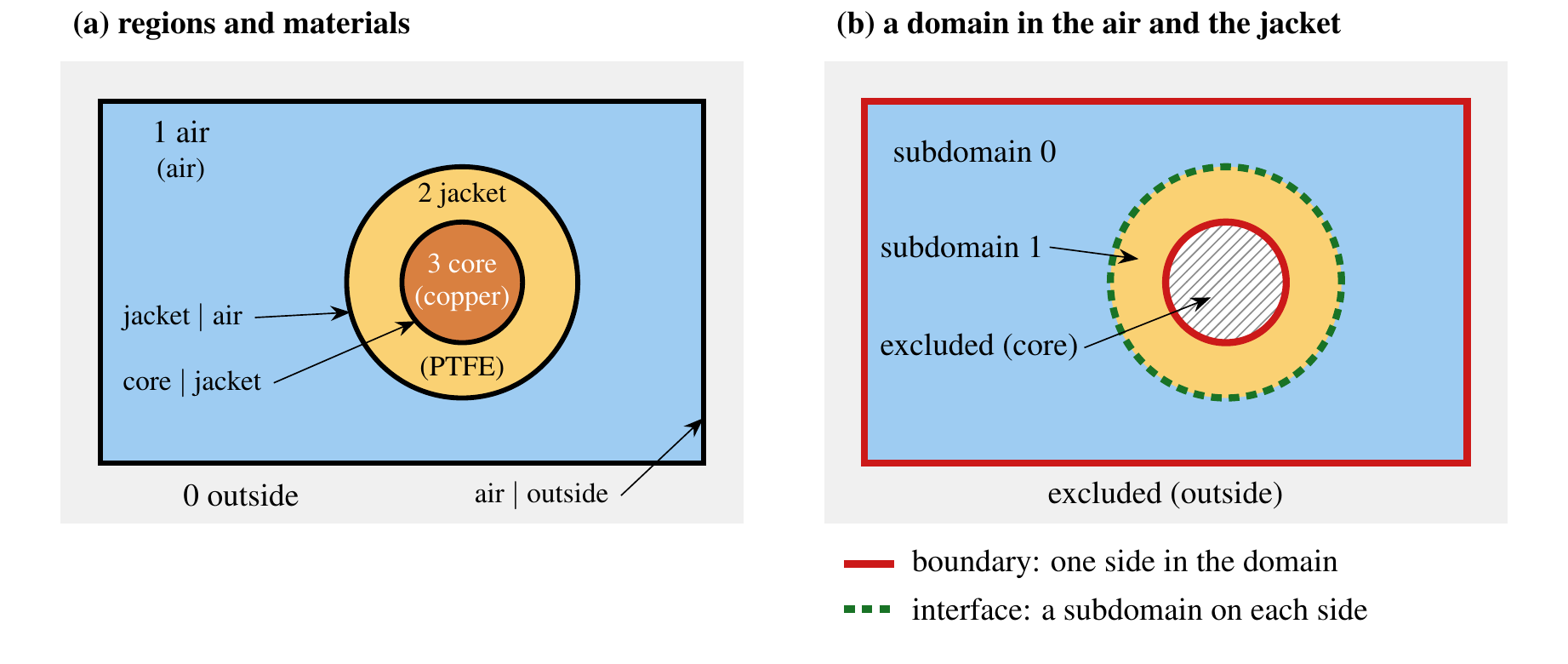
Fig. 9 A cable in a box of air, in a cross-section. (a) Three regions, each of a material, over the outside, and the pieces of surface between them. (b) A domain computing in the air and the jacket: two subdomains, the core and the outside excluded. The surface between the two subdomains is an interface, and the surfaces where the domain meets the excluded regions are its boundary.
Regions
An overlay of shapes makes an object of regions: each shape is a region, and where shapes overlap, the later one lies on top. In Fig. 9 (a) the air is a box, the jacket a cylinder over it, and the core a thinner cylinder over the jacket: the jacket’s region is the jacket minus the core, the air’s the box minus both. The regions tile the object, with no gaps and no overlaps, so that every point is in exactly one of them. The space beyond every shape is the outside, region 0. A medium around an object (the air around the cable) is a region like the others, the first of the overlay, whose outer surface bounds what a program computes in.
Each region has a function of its own, negative exactly inside it, whose zero level is the region’s whole surface, the interfaces with its neighbors included: the function a cut-cell code cuts for that region. The object as a whole is still one shape, the union of its regions, so it composes, renders and ray traces as any shape does.
An overlay may be moved, clipped or drilled (as the first operand of an intersection or a difference, which remove space from every region), and placed in another overlay as one of its regions: its regions then take its place in the outer overlay’s order and stay together as a region group. Anything that would make it unclear which region a point belongs to, such as a union of an overlay with another solid, or an offset or a blend of one, is rejected when the object is built.
Materials
A region is named for which part of the object it is (the jacket) and labeled with a material, what it is made of (PTFE). Two regions of the same material are still two regions: an inner and an outer insulation layer, say, may differ in their conditions though both are PTFE. A material carries no numbers in EBGeometry; it is a name a program attaches properties to, in its own code or in a model file (see The .ebg language).
Pieces of surface
A surface between two regions has a region, and a material, on each side. Where a shape’s surface separates two regions, it is a piece of the object’s surface: the jacket’s cylinder between the jacket and the air is one piece, and between the jacket and the core (where the core’s surface lies) there is none, since the core’s own cylinder is the surface there. A piece is named by the shape it comes from and the regions on its two sides; it is the unit a domain assigns conditions to, and the thing a viewer picks when a surface is clicked.
The sides belong to the point, not to the shape: one shape’s surface can separate different regions in different places. A ball centered on another ball’s surface faces the air on one half and the other ball on the other half, and is two pieces.
Domains
A domain is what one computation runs on (Fig. 9 (b)). It has two parts.
Subdomains. Each subdomain is a set of regions the computation runs in, usually one, sometimes several (a region group, or every region of a material). Regions in no subdomain are excluded: the computation does not run there (a conductor held at a potential, the outside). Every point is therefore in one subdomain, or excluded, and each subdomain, and the excluded regions together, has a function negative exactly there. A cut-cell code samples these at the nodes of its grid: an edge whose two ends are in different subdomains (or one is excluded) crosses a surface, and the root of the right function along the edge is where.
Roles. From the sides of a surface at a point, the domain gives it a role:
a boundary, with one side in the domain and the other excluded (the box’s outer faces, and the core’s surface, in the figure);
an interface, with a different subdomain on each side (the jacket’s outer surface);
internal, with two regions of the same subdomain on its two sides, which a computation usually does not cut;
or none, when neither side is in the domain.
Surface groups. A domain also sorts the surfaces it touches into surface groups, one per condition it applies: “inlet”, “wall”, “held at 0 V”. A surface group is a list of selectors, each saying what a surface is, never where: a piece, every surface with a surface label (see Leaves, surfaces and labels), the interface between two regions, every surface of a region, the surfaces between two materials, or the rest, every surface no other selector holds. The selectors of a domain are tried in the order they were added, across all its groups, and the first that holds a surface puts it in its group; the rest is tried last, wherever it was added. So a group of a few special pieces can be followed by a broader one that takes what remains.
A domain is complete when every piece of surface it touches is in a surface group. EBGeometry checks that from the object’s description alone, listing every piece the object may have (a few listed may turn out to have no area) and how far the surface groups hold each one: wholly, partly (some faces of a box or a mesh) or not at all. It can also find which pieces the object actually has, by crossing it with rays.
Several domains can share one object, each a different computation: the same air is the fluid of a flow computation and a dielectric of an electrostatic one, and the same surface can be a boundary of one and an interface of the other.
Connected components
A region is a part of space, not necessarily one piece of it. Two balls in one region may or may not touch, a difference can cut a bar into three, and a hollow shell seals off a cavity that is part of the outside: the expression says what each region is, never how many pieces it has. A connected component is one such piece: a connected part of space all in one region (or in one subdomain, or in one material). A solver needs to know about them: an enclosed pocket of gas, cut off from the rest, needs its own initial state, a conductor touching nothing needs its own potential, and many solvers ask for a point in each piece to name it.
Only the geometry decides, so EBGeometry finds the components by searching space at a resolution h, the size of the smallest cells of the search, which are placed only near surfaces. For each component it gives a point inside it, its volume and box (approximate, within about h), the components it touches, and whether it reaches the box searched; one that does not is enclosed, a cavity or a floating body.
What h means. Two pieces joined by a neck thinner than h, or separated by a wall thinner than h, may count as one, and a piece thinner than h may be missed. With h the cell size of the solver the components are for, the components found are the ones that solver sees, which is usually what is wanted: a gap the solver cannot resolve does not separate two volumes for it.
Memory. The search keeps its cells, so its memory grows like its time, with the area of the surfaces over h squared: halving h takes about four times as much. It stops at a cap on the cells (with a message saying so), set by default to keep it under ten gigabytes; a finer search needs a smaller box or a raised cap, both options of the C++ call (see Regions and domains).
The search needs the functions to be distances or bounds on them (a distance quality other than
NotADistance): it shows
that a cell lies wholly in one region from the distance to its surface, and an object whose value is only a
sign is rejected.
Along a ray
A particle crossing the object crosses from region to region. The first point along a ray, or along a particle’s step, where the region changes is found exactly where the shapes have exact ray forms (see Exact ray tracing), with the surface crossed, its surface labels, and the regions left and entered. A ray can also be asked where it first enters or leaves a set of regions, passing through the surfaces between them: what a renderer needs to show some regions and see through the others.
Regions and domains describes the classes and calls, and Materials builds the cable, its regions and a domain, and renders them.