Twist
An operation of your own: a twist about the \(y\) axis, applied to a mesh read from a file. The
source is at Examples/Twist/main.cpp.
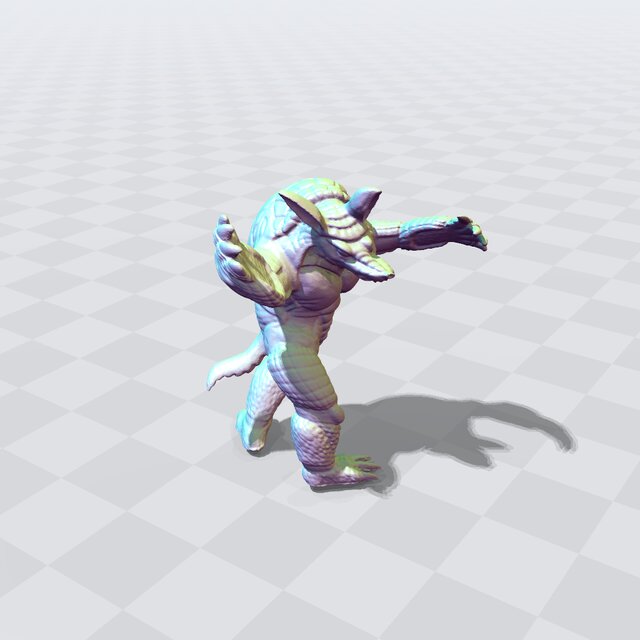
Fig. 32 The twisted armadillo.
Important
The default mesh comes from the common-3d-test-models git submodule. Clone with
--recurse-submodules, or run git submodule update --init in the repository (see
Obtaining EBGeometry); otherwise pass a mesh of your own as the first argument.
Writing the operation
Twisted<S> is a trivially copyable struct holding a shape S (here a Tape of the placed mesh;
any shape works) and a twist rate. Its signedDistance(p) turns p back about the \(y\) axis by
the rate times p[1] and evaluates the shape there; computeBoundingVolume() is the shape’s box
swept around the axis. Like any shape of your own (see CustomShape), it also says how
far its value can be trusted:
static constexpr DistanceQuality distanceQuality = DistanceQuality::Bound;
A twist is not a rigid motion: at distance \(r\) from the axis it shears by \(a = kr\) for a rate \(k\), which stretches lengths by up to \((a + \sqrt{a^2 + 4})/2\), the largest singular value of the shear. Sphere tracing (the renderer) and BVH pruning evaluate a shape only inside its box, a square of half-width \(R\) about the axis whose corners are \(\sqrt{2}R\) from it; dividing the value by the factor there, with \(a = \sqrt{2}kR\), keeps it a lower bound on the distance, which is what they need.
Using it
The program prints the original’s and the twisted copy’s values at three heights; at \(y = 0\) the
twist turns nothing and the two differ only by the factor. Like any shape of your own, the twisted
statue can also go into a tape, listed after T (see CustomShape). The library
has no built-in twist operation yet (none in the tape, the fused operations or the ray forms), which is
why this example defines its own.
Looking at it
The example ends with Render::view(twisted, pool, argc, argv), a window on the twisted armadillo. It
has no ray form, so the renderer sphere traces it, which the bound makes safe. In a GPU build the window
renders on the device, through rebasedView(): Twisted gives the view of its shape onto a mirror
of the pool, as the library’s own wrappers do.
The window needs SDL2 and is built with make VIEWER=SDL2 or cmake -DEBGEOMETRY_VIEWER=SDL2 (see
The viewer window (EBGEOMETRY_VIEWER)); otherwise, and with --no-view or without a display, view() prints why
and returns. Drag to orbit and scroll to zoom; the window lists its other keys (see
The viewer’s keys).
Building and running
See Building for how to compile it with CMake, GNU Make, or a direct compiler invocation. Built for a GPU (see Running on a GPU), the window renders on the device.
cd Examples/Twist
./Twist.ex