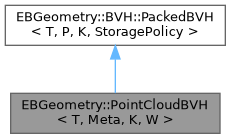
A PackedBVH specialized for point clouds, with a fast build and turnkey queries. More...
#include <EBGeometry_PointCloudBVH.hpp>

Classes | |
| struct | Hit |
| One query result: the cloud index of a matched point and its squared distance. More... | |
Public Types | |
| using | PointGroup = PointAoSoA< T, std::size_t, W > |
| The SoA leaf primitive: a group of up to W points carrying their cloud indices. | |
| using | Base = BVH::PackedBVH< T, PointGroup, K, BVH::ValueStorage< PointGroup > > |
| The general packed BVH this specializes. | |
| using | Node = typename Base::Node |
| Flat node type inherited from Base. | |
| using | AABB = BoundingVolumes::AABBT< T > |
| Axis-aligned bounding box type. | |
 Public Types inherited from EBGeometry::BVH::PackedBVH< T, P, K, StoragePolicy > Public Types inherited from EBGeometry::BVH::PackedBVH< T, P, K, StoragePolicy > | |
| using | BV = EBGeometry::BoundingVolumes::AABBT< T > |
| AABB type used for all bounding volumes in this BVH. | |
| using | StorageType = typename StoragePolicy::StorageType |
| Storage representation of one entry in the primitive array, as determined by StoragePolicy (std::shared_ptr<const P> for the default SharedPtrStorage. | |
Public Member Functions | |
| PointCloudBVH ()=delete | |
| No default construction – a point cloud is required. | |
| PointCloudBVH (const std::vector< Vec3T< T > > &a_positions, const std::vector< Meta > &a_metadata, std::size_t a_targetLeafSize=16 *W) | |
| Build a BVH over a point cloud. | |
| Hit | closestPoint (const Vec3T< T > &a_query) const noexcept |
| Closest cloud point to an arbitrary query point. | |
| std::size_t | closestPoints (const Vec3T< T > &a_query, std::size_t a_k, Hit *a_out) const noexcept |
| The a_k closest cloud points to an arbitrary query point, nearest first. | |
| Hit | nearestNeighbor (std::size_t a_point) const noexcept |
| Nearest other point to a point already in the cloud (seed-from-own-leaf search). | |
| std::size_t | nearestNeighbors (std::size_t a_point, std::size_t a_k, Hit *a_out) const noexcept |
| The a_k nearest other points to a point already in the cloud, nearest first. | |
| std::vector< Hit > | allNearestNeighbors (std::size_t a_k=1) const |
| For every point, its a_k nearest other points (the k-nearest-neighbor graph). | |
| Hit | closestPointBruteForce (const Vec3T< T > &a_query) const noexcept |
| Brute-force closest point to an arbitrary query point (O(N) reference for closestPoint()). | |
| std::size_t | closestPointsBruteForce (const Vec3T< T > &a_query, std::size_t a_k, Hit *a_out) const |
| Brute-force a_k closest points to an arbitrary query point (O(N) reference for closestPoints()). | |
| Hit | nearestNeighborBruteForce (std::size_t a_point) const noexcept |
| Brute-force nearest other point to a cloud point (O(N) reference for nearestNeighbor()). | |
| std::size_t | nearestNeighborsBruteForce (std::size_t a_point, std::size_t a_k, Hit *a_out) const |
| Brute-force a_k nearest other points to a cloud point (O(N) reference for nearestNeighbors()). | |
| std::size_t | numPoints () const noexcept |
| Number of points in the cloud. | |
| const Vec3T< T > & | position (std::size_t a_index) const noexcept |
| Position of the point with the given cloud index. | |
| const Meta & | metadata (std::size_t a_index) const noexcept |
| User metadata of the point with the given cloud index. | |
| Public Member Functions inherited from EBGeometry::BVH::PackedBVH< T, P, K, StoragePolicy > | |
| PackedBVH ()=delete | |
| Deleted default constructor. Use TreeBVH::pack() or TreeBVH::packWith() to construct. | |
| PackedBVH (const TreeBVH< T, P, BV, K > &a_tree) | |
| Construct by packing a TreeBVH (identity primitive type). | |
| template<class Q , class Converter > | |
| PackedBVH (const TreeBVH< T, Q, BV, K > &a_tree, Converter &&a_converter) | |
| Construct by packing a TreeBVH with primitive-type conversion. | |
| template<class S = SFC::Morton> | |
| PackedBVH (std::vector< std::pair< P, BV > > a_primsAndBVs, size_t a_targetLeafSize, S a_sfc=S{}) | |
| Construct directly from a flat primitive list, without ever building a TreeBVH. | |
| PackedBVH (std::vector< std::pair< P, BV > > a_primsAndBVs, const BVH::Partitioner< P, BV, K > &a_partitioner=BVCentroidPartitioner< T, P, BV, K >, const BVH::LeafPredicate< T, P, BV, K > &a_stopCrit=DefaultLeafPredicate< T, P, BV, K >) | |
| Construct directly from a flat primitive list via top-down (optionally SAH) recursive partitioning, without ever building a TreeBVH. | |
| PackedBVH (std::vector< std::pair< P, BV > > a_primsAndBVs, BVH::ClusterSpec a_spec) | |
| Construct directly via ClusterSAH: cluster primitives, then SAH over the clusters. | |
| ~PackedBVH ()=default | |
| Destructor. | |
| PackedBVH (const PackedBVH &a_other)=default | |
| Copy constructor. | |
| PackedBVH & | operator= (const PackedBVH &a_other)=default |
| Copy assignment operator. | |
| PackedBVH (PackedBVH &&a_other) noexcept=default | |
| Move constructor. | |
| PackedBVH & | operator= (PackedBVH &&a_other) noexcept=default |
| Move assignment operator. | |
| const std::vector< StorageType > & | getPrimitives () const noexcept |
| Get the global primitive list (in leaf-traversal order). | |
| const BV & | getBoundingVolume () const noexcept |
| Get the bounding volume of the root node. | |
| BV | computeBoundingVolume () const noexcept |
| Compute and return the bounding volume of this BVH. | |
| template<class NodeKey > | |
| void | traverse (const BVH::PackedLeafEvaluator< P, StoragePolicy > &a_leafEvaluator, const BVH::PrunePredicate< Node, NodeKey > &a_prunePredicate, const BVH::PackedChildOrderer< NodeKey, K > &a_childOrderer, const BVH::NodeKeyFactory< Node, NodeKey > &a_nodeKeyFactory) const noexcept |
| Recursion-free BVH traversal using a vector-backed LIFO stack (depth-first order). | |
| template<class State , class LeafEvaluator , class PruneDistSquared > | |
| void | pruneTraverse (const Vec3T< T > &a_point, State &a_state, LeafEvaluator &&a_evalLeaf, PruneDistSquared &&a_pruneDist2) const noexcept |
| Generic SIMD-accelerated, distance-pruned traversal. | |
| template<class BVConstructor > | |
| void | refit (const BVConstructor &a_bvConstructor) |
| Refit every node's bounding volume in place after the primitives have moved. | |
Additional Inherited Members | |
| Protected Member Functions inherited from EBGeometry::BVH::PackedBVH< T, P, K, StoragePolicy > | |
| PackedBVH (std::vector< Node > &&a_linearNodes, std::vector< StorageType > &&a_primitives) noexcept | |
| Adopt pre-built node and primitive arrays, then finalize the SoA child-AABB layout. | |
| void | buildSoA () |
| Populate m_childAabbSoA from the completed m_linearNodes array. | |
| Protected Attributes inherited from EBGeometry::BVH::PackedBVH< T, P, K, StoragePolicy > | |
| std::vector< Node > | m_linearNodes |
| Flat depth-first node array. | |
| std::vector< StorageType > | m_primitives |
| Global primitive list in leaf-traversal order. | |
| std::vector< ChildAABBSoA > | m_childAabbSoA |
| Per-node SoA AABB cache used by the SIMD traversal in pruneTraverse(). | |
Detailed Description
class EBGeometry::PointCloudBVH< T, Meta, K, W >
A PackedBVH specialized for point clouds, with a fast build and turnkey queries.
Unlike the general PackedBVH constructors (which take a list of pre-made primitives and partition it via SAH/Midpoint/SFC), PointCloudBVH is built directly from a raw point cloud – positions plus a parallel array of user metadata. It uses an index-based, copy-free top-down build (partition an index permutation in place by longest-axis midpoint, pack leaves into PointAoSoA<T, size_t, W> groups inline), which is far cheaper than the general path and produces a tree just as tight for near-uniform clouds.
Every leaf carries the point's cloud index (its position in the input arrays) as metadata, so queries return that index; the user's own metadata is stored alongside and reachable via metadata(). The class hides all of pruneTraverse()/the SoA leaf kernel/the seed-from-own-leaf optimization behind a few high-level query methods.
- Note
- Queries come in two flavours. External queries (closestPoint / closestPoints) take an arbitrary point and traverse top-down. Self queries (nearestNeighbor / nearestNeighbors), and the batch allNearestNeighbors(), take a point already in the cloud and additionally seed the search bound from the leaf that point lives in (skipping that leaf during traversal) – a strictly cheaper search that an external point cannot use.
- Template Parameters
-
T Floating-point precision. Meta User metadata type stored per point and returned via metadata(). Defaults to the cloud index itself (std::size_t). K BVH branching factor. Defaults to the SIMD-optimal value for T. W Points per SoA leaf lane group. Defaults to the SIMD-optimal width for T.
Constructor & Destructor Documentation
◆ PointCloudBVH()
|
inline |
Build a BVH over a point cloud.
- Parameters
-
[in] a_positions Point positions. [in] a_metadata Per-point user metadata (same length/order as a_positions). [in] a_targetLeafSize Target points per leaf (the build stops splitting at or below it).
Member Function Documentation
◆ allNearestNeighbors()
|
inline |
For every point, its a_k nearest other points (the k-nearest-neighbor graph).
Processes points in leaf (build) order – already spatially coherent, so consecutive queries touch nearby leaves and stay hot in cache, with no per-call sort – and seeds each from its own leaf, so the whole batch is cheaper than the sum of independent queries. Result is flattened row-major: entry [i*a_k + j] is the j-th nearest neighbor of point i (ascending by distance).
- Parameters
-
[in] a_k Number of neighbors per point.
- Returns
- A vector of size numPoints()*a_k of Hits.
◆ closestPoint()
|
inlinenoexcept |
Closest cloud point to an arbitrary query point.
- Parameters
-
[in] a_query Query point (need not be in the cloud).
- Returns
- The nearest point and its squared distance.
◆ closestPointBruteForce()
|
inlinenoexcept |
Brute-force closest point to an arbitrary query point (O(N) reference for closestPoint()).
Full linear scan. Same result contract as closestPoint().
- Parameters
-
[in] a_query Query point (need not be in the cloud).
- Returns
- The nearest point and its squared distance.
- Warning
- For debugging and testing only – an O(N) reference implementation, never a hot path.
◆ closestPoints()
|
inlinenoexcept |
The a_k closest cloud points to an arbitrary query point, nearest first.
- Parameters
-
[in] a_query Query point (need not be in the cloud). [in] a_k Number of neighbors requested. [out] a_out Buffer of at least a_k Hits; filled [0, returned count), ascending by distance.
- Returns
- The number of neighbors found (min(a_k, cloud size)).
◆ closestPointsBruteForce()
|
inline |
Brute-force a_k closest points to an arbitrary query point (O(N) reference for closestPoints()).
Full linear scan. Same result contract as closestPoints().
- Parameters
-
[in] a_query Query point (need not be in the cloud). [in] a_k Number of neighbors requested. [out] a_out Buffer of at least a_k Hits; filled [0, returned count), ascending by distance.
- Returns
- The number of neighbors found (min(a_k, cloud size)).
- Warning
- For debugging and testing only – an O(N*k) reference implementation, never a hot path.
◆ metadata()
|
inlinenoexcept |
User metadata of the point with the given cloud index.
- Parameters
-
[in] a_index Cloud index.
- Returns
- The point's user metadata.
◆ nearestNeighbor()
|
inlinenoexcept |
Nearest other point to a point already in the cloud (seed-from-own-leaf search).
- Parameters
-
[in] a_point Cloud index of the query point; excluded from its own result.
- Returns
- The nearest other point and its squared distance.
◆ nearestNeighborBruteForce()
|
inlinenoexcept |
Brute-force nearest other point to a cloud point (O(N) reference for nearestNeighbor()).
Full linear scan excluding the point itself. Same result contract as nearestNeighbor().
- Parameters
-
[in] a_point Cloud index of the query point; excluded from its own result.
- Returns
- The nearest other point and its squared distance.
- Warning
- For debugging and testing only – an O(N) reference implementation, never a hot path.
◆ nearestNeighbors()
|
inlinenoexcept |
The a_k nearest other points to a point already in the cloud, nearest first.
- Parameters
-
[in] a_point Cloud index of the query point; excluded from its own result. [in] a_k Number of neighbors requested. [out] a_out Buffer of at least a_k Hits; filled [0, returned count), ascending.
- Returns
- The number of neighbors found (min(a_k, cloud size - 1)).
◆ nearestNeighborsBruteForce()
|
inline |
Brute-force a_k nearest other points to a cloud point (O(N) reference for nearestNeighbors()).
Full linear scan excluding the point itself. Same result contract as nearestNeighbors().
- Parameters
-
[in] a_point Cloud index of the query point; excluded from its own result. [in] a_k Number of neighbors requested. [out] a_out Buffer of at least a_k Hits; filled [0, returned count), ascending.
- Returns
- The number of neighbors found (min(a_k, cloud size - 1)).
- Warning
- For debugging and testing only – an O(N*k) reference implementation, never a hot path.
◆ numPoints()
|
inlinenoexcept |
Number of points in the cloud.
- Returns
- The point count.
◆ position()
|
inlinenoexcept |
Position of the point with the given cloud index.
- Parameters
-
[in] a_index Cloud index.
- Returns
- The point's position.
The documentation for this class was generated from the following file:
- Source/EBGeometry_PointCloudBVH.hpp