Forward declaration of the tree-structured BVH. Needed by LeafPredicate and the default-partitioner lambdas defined below. More...
#include <EBGeometry_BVH.hpp>
Public Types | |
| using | PrimitiveList = BVH::PrimitiveList< P > |
| Alias for the primitive list type. | |
| using | Vec3 = Vec3T< T > |
| Alias for the 3D vector type. | |
| using | Node = TreeBVH< T, P, BV, K > |
| Alias for this node type (used in traversal callbacks). | |
| using | NodePtr = std::shared_ptr< Node > |
| Alias for a shared pointer to a node. | |
| using | Partitioner = BVH::Partitioner< P, BV, K > |
| Alias for the partitioner type. | |
| using | LeafPredicate = BVH::LeafPredicate< T, P, BV, K > |
| Alias for the stop-function type. | |
Public Member Functions | |
| TreeBVH () noexcept | |
| Default constructor. Creates an empty interior node. | |
| TreeBVH (const std::vector< PrimAndBV< P, BV > > &a_primsAndBVs) | |
| Construct a leaf node from a set of (primitive, BV) pairs. | |
| TreeBVH (std::vector< PrimAndBV< P, BV > > &&a_primsAndBVs) | |
| Construct a leaf node holding the given (primitive, bounding volume) pairs, moved in. | |
| ~TreeBVH () noexcept=default | |
| Destructor. | |
| TreeBVH (const TreeBVH &a_other)=delete | |
| Deleted copy constructor. | |
| TreeBVH & | operator= (const TreeBVH &a_other)=delete |
| Deleted copy assignment operator. | |
| TreeBVH (TreeBVH &&a_other) noexcept=default | |
| Move constructor. | |
| TreeBVH & | operator= (TreeBVH &&a_other) noexcept=default |
| Move assignment operator. | |
| void | topDownSortAndPartition (const Partitioner &a_partitioner=BVCentroidPartitioner< T, P, BV, K >, const LeafPredicate &a_stopCrit=DefaultLeafPredicate< T, P, BV, K >) |
| Recursively partition this node top-down. | |
| template<typename S > | |
| void | bottomUpSortAndPartition () |
| Recursively partition this node bottom-up along a space-filling curve. | |
| bool | isLeaf () const noexcept |
| Return true if this is a leaf node (no children, non-empty primitive list). | |
| bool | isPartitioned () const noexcept |
| Return true if the tree has already been partitioned. | |
| const BV & | getBoundingVolume () const noexcept |
| Get the bounding volume for this node. | |
| const PrimitiveList & | getPrimitives () const noexcept |
| Get the primitives stored in this node. | |
| const std::vector< BV > & | getBoundingVolumes () const noexcept |
| Get the per-primitive bounding volumes stored in this node. | |
| T | getDistanceToBoundingVolume (const Vec3 &a_point) const noexcept |
| Get the distance from a_point to this node's bounding volume. | |
| const std::array< std::shared_ptr< TreeBVH< T, P, BV, K > >, K > & | getChildren () const noexcept |
| Get the K child nodes of this interior node. | |
| std::shared_ptr< TreeBVH< T, P, BV, K > > | deepCopy () const |
| Produce an independent deep copy of this tree. | |
| template<class NodeKey > | |
| void | traverse (const BVH::LeafEvaluator< P > &a_leafEvaluator, const BVH::PrunePredicate< Node, NodeKey > &a_prunePredicate, const BVH::ChildOrderer< Node, NodeKey, K > &a_childOrderer, const BVH::NodeKeyFactory< Node, NodeKey > &a_nodeKeyFactory) const noexcept |
| Recursion-free BVH traversal using an explicit LIFO stack (depth-first order). | |
| template<class BVConstructor > | |
| const BV & | refit (const BVConstructor &a_bvConstructor) |
| Refit this subtree's bounding volumes in place after its primitives have moved. | |
| template<class StoragePolicy = BVH::SharedPtrStorage<P>> | |
| std::shared_ptr< PackedBVH< T, P, K, StoragePolicy > > | pack () const |
| Flatten this tree into a cache-friendly PackedBVH with the same primitive type. | |
| template<class Q , class Converter , class StoragePolicy = BVH::SharedPtrStorage<Q>> | |
| std::shared_ptr< PackedBVH< T, Q, K, StoragePolicy > > | packWith (Converter &&a_converter) const |
| Flatten and convert this tree into a PackedBVH with a different primitive type Q. | |
Protected Member Functions | |
| PrimitiveList & | getPrimitives () noexcept |
| Non-const accessor for the primitive list (used during construction). | |
| std::vector< BV > & | getBoundingVolumes () noexcept |
| Non-const accessor for the per-primitive bounding volumes (used during construction). | |
| void | setChildren (const std::array< std::shared_ptr< TreeBVH< T, P, BV, K > >, K > &a_children) noexcept |
| Set the K child nodes, converting this node from a leaf into an interior node. | |
Protected Attributes | |
| BV | m_boundingVolume |
| Bounding volume enclosing all primitives in this subtree. | |
| bool | m_partitioned |
| True after topDownSortAndPartition() or bottomUpSortAndPartition() has been called. | |
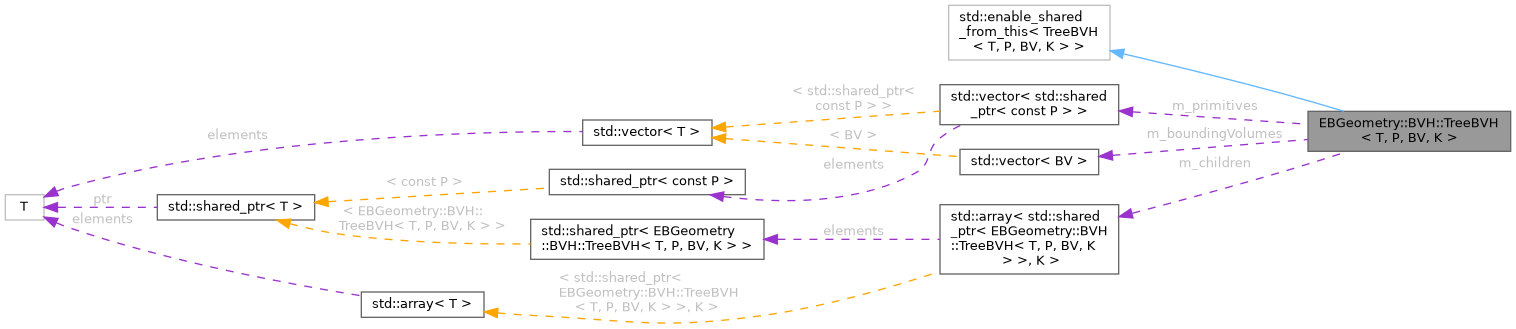
| std::vector< std::shared_ptr< const P > > | m_primitives |
| Primitives stored in this node. Non-empty for leaf nodes only. | |
| std::vector< BV > | m_boundingVolumes |
| Per-primitive bounding volumes. Non-empty for leaf nodes only. | |
| std::array< std::shared_ptr< TreeBVH< T, P, BV, K > >, K > | m_children |
| K child nodes. Non-null for interior nodes only. | |
Detailed Description
Forward declaration of the tree-structured BVH. Needed by LeafPredicate and the default-partitioner lambdas defined below.
Tree-structured BVH node used during construction.
Each node stores a bounding volume, a list of primitives (non-empty for leaf nodes only), and K child pointers (non-null for interior nodes only).
Build the tree by constructing a root node from a set of (primitive, BV) pairs and then calling topDownSortAndPartition() or bottomUpSortAndPartition(). Once built, call pack() to obtain a cache-friendly PackedBVH for traversal.
- Template Parameters
-
T Floating-point precision. P Primitive type. Must provide getCentroid() – construction/partitioning never calls any other method on it. PackedBVH itself imposes no interface requirement on P either; any further requirement comes entirely from whatever leaf-eval a caller passes to PackedBVH::pruneTraverse() or PackedBVH::traverse() (see PackedBVH below). BV Bounding volume type. K Tree branching factor (must be >= 2).
Constructor & Destructor Documentation
◆ TreeBVH() [1/4]
| EBGeometry::BVH::TreeBVH< T, P, BV, K >::TreeBVH | ( | const std::vector< PrimAndBV< P, BV > > & | a_primsAndBVs | ) |
Construct a leaf node from a set of (primitive, BV) pairs.
- Parameters
-
[in] a_primsAndBVs Primitives and their bounding volumes.
◆ TreeBVH() [2/4]
| EBGeometry::BVH::TreeBVH< T, P, BV, K >::TreeBVH | ( | std::vector< PrimAndBV< P, BV > > && | a_primsAndBVs | ) |
Construct a leaf node holding the given (primitive, bounding volume) pairs, moved in.
Rvalue overload: transfers the elements without copying or shared_ptr refcount churn. Used where a caller can relinquish its list (e.g. topDownSortAndPartition moving a partitioner's sub-list into a child node).
- Parameters
-
[in,out] a_primsAndBVs Primitives and their bounding volumes (consumed).
◆ TreeBVH() [3/4]
|
delete |
Deleted copy constructor.
A TreeBVH is a recursive structure of shared_ptr-linked children (m_children); a compiler-generated copy would only alias the same child subtrees rather than cloning them. topDownSortAndPartition()/bottomUpSortAndPartition() mutate a node's children in place, so such a "copy" could silently share mutable state with the original instead of being independent. Disallowed outright rather than doing the wrong thing; use deepCopy() to replicate a tree independently.
- Parameters
-
[in] a_other Other instance (unused; deleted).
◆ TreeBVH() [4/4]
|
defaultnoexcept |
Move constructor.
Explicitly defaulted: the user-declared destructor above would otherwise suppress the implicitly-generated move constructor.
- Parameters
-
[in,out] a_other Other instance to move from.
Member Function Documentation
◆ bottomUpSortAndPartition()
|
inline |
Recursively partition this node bottom-up along a space-filling curve.
S must provide encode() and decode() functions returning SFC indices. Primitives are sorted by their bounding-volume centroid projected onto the curve, then grouped into leaves of size K and merged upwards to the root.
- Template Parameters
-
S Space-filling curve type (e.g. Morton, Nested).
◆ deepCopy()
|
inline |
Produce an independent deep copy of this tree.
Recursively clones the node hierarchy: the returned tree owns brand-new nodes, so it can be partitioned or otherwise mutated without affecting this tree (and vice versa). The copy constructor is deleted precisely because a shallow copy would instead alias these mutable child nodes; this is the explicit, correct way to replicate a tree. Primitives are shared, not cloned – each node's std::shared_ptr<const P> entries are copied by handle, matching how a TreeBVH normally references its (immutable) primitives, e.g. faces shared with a DCEL mesh. Works in either state: an unpartitioned tree clones to an unpartitioned leaf (build once, then partition the copies differently), and a partitioned tree clones its full sub-structure.
- Returns
- Shared pointer to an independent clone of this tree.
◆ getBoundingVolume()
|
inlinenoexcept |
Get the bounding volume for this node.
- Returns
- Reference to m_boundingVolume.
◆ getBoundingVolumes() [1/2]
|
inlinenoexcept |
Get the per-primitive bounding volumes stored in this node.
Non-empty only for leaf nodes.
- Returns
- Reference to m_boundingVolumes.
◆ getBoundingVolumes() [2/2]
|
inlineprotectednoexcept |
Non-const accessor for the per-primitive bounding volumes (used during construction).
- Returns
- Reference to m_boundingVolumes.
◆ getChildren()
|
inlinenoexcept |
Get the K child nodes of this interior node.
All K children are non-null for interior nodes; the array is unused for leaf nodes.
- Returns
- Reference to m_children.
◆ getDistanceToBoundingVolume()
|
inlinenoexcept |
Get the distance from a_point to this node's bounding volume.
Returns zero if a_point is inside the bounding volume.
- Parameters
-
[in] a_point Query point.
- Returns
- Distance to the bounding volume surface, or zero if inside.
◆ getPrimitives() [1/2]
|
inlinenoexcept |
Get the primitives stored in this node.
Non-empty only for leaf nodes.
- Returns
- Reference to m_primitives.
◆ getPrimitives() [2/2]
|
inlineprotectednoexcept |
Non-const accessor for the primitive list (used during construction).
- Returns
- Reference to m_primitives.
◆ isLeaf()
|
inlinenoexcept |
Return true if this is a leaf node (no children, non-empty primitive list).
- Returns
- True if this node holds primitives directly (i.e. is a leaf).
◆ isPartitioned()
|
inlinenoexcept |
Return true if the tree has already been partitioned.
- Returns
- True if topDownSortAndPartition() or bottomUpSortAndPartition() has been called.
◆ operator=() [1/2]
|
delete |
Deleted copy assignment operator.
See the copy constructor for why copying is disallowed.
- Parameters
-
[in] a_other Other instance (unused; deleted).
- Returns
- Reference to *this (unused; deleted).
◆ operator=() [2/2]
|
defaultnoexcept |
Move assignment operator.
- Parameters
-
[in,out] a_other Other instance to move from.
- Returns
- Reference to *this.
◆ pack()
|
inline |
Flatten this tree into a cache-friendly PackedBVH with the same primitive type.
Requires BV == AABBT<T>; enforced by static_assert at instantiation.
- Template Parameters
-
StoragePolicy Storage policy for the resulting PackedBVH's primitive array (default: BVH::SharedPtrStorage<P>, matching every existing caller that does not name one explicitly).
- Returns
- Shared pointer to the resulting PackedBVH.
◆ packWith()
|
inline |
Flatten and convert this tree into a PackedBVH with a different primitive type Q.
a_converter is called once per leaf: a_converter(leafPrims, 0, count) → std::vector<Q> All returned values are accumulated into a single contiguous buffer, then exposed through the resulting PackedBVH's storage policy (StorageType) to preserve cache locality. Requires BV == AABBT<T>; enforced by static_assert at instantiation.
- Template Parameters
-
Q Destination primitive type. Converter Callable: (PrimitiveList
, uint32_t offset, uint32_t count) → std::vector<Q>.
- Template Parameters
-
StoragePolicy Storage policy for the resulting PackedBVH's primitive array (default: BVH::SharedPtrStorage<Q>, matching every existing caller that does not name one explicitly).
- Parameters
-
[in] a_converter Leaf-conversion function.
- Returns
- Shared pointer to the resulting PackedBVH<T, Q, K, StoragePolicy>.
◆ refit()
|
inline |
Refit this subtree's bounding volumes in place after its primitives have moved.
Keeps the tree topology – the node hierarchy and each leaf's primitive assignment – exactly as it is, recomputing only the bounding volumes bottom-up: at every leaf, each primitive's bounding volume is recomputed via a_bvConstructor and the leaf's node volume is set to their union; at every interior node, the node volume is set to the union of its K children's (already-refitted) volumes. This is the cheap way to keep a BVH valid for a moving geometry – primitives that shift a little between frames without changing which leaf they belong to – avoiding a full rebuild-and-repack. Because it never re-partitions, a geometry that has deformed enough for primitives to migrate across the tree will accumulate looser (lower query quality) bounding volumes over time and should periodically be rebuilt from scratch instead.
The primitives are reached by handle (std::shared_ptr<const P>): a_bvConstructor is called with each primitive and must return that primitive's current bounding volume. Whatever moved the geometry is expected to have updated the state the primitives read (e.g. a shared DCEL mesh's vertex positions) before refit() is called.
- Template Parameters
-
BVConstructor Callable: (const P&) -> BV, returning one primitive's current bounding volume.
- Parameters
-
[in] a_bvConstructor Bounding-volume constructor for a single primitive.
- Returns
- Reference to this node's refitted bounding volume (so a parent can union its children).
◆ setChildren()
|
inlineprotectednoexcept |
Set the K child nodes, converting this node from a leaf into an interior node.
- Parameters
-
[in] a_children New child nodes.
◆ topDownSortAndPartition()
|
inline |
Recursively partition this node top-down.
The stop criterion and partitioner determine the tree shape.
- Parameters
-
[in] a_partitioner Partitioning function. Divides a (primitive, BV) list into K sub-lists. [in] a_stopCrit Stop function. Returns true when a node should become a leaf.
◆ traverse()
|
inlinenoexcept |
Recursion-free BVH traversal using an explicit LIFO stack (depth-first order).
The traversal maintains a stack of (node, NodeKey) pairs. It is seeded with the root node paired with a_nodeKeyFactory applied to the root. On each iteration:
- Pop the top (node, nodeKey) pair.
- Call
a_prunePredicate(node, nodeKey). If it returns false the entire subtree rooted at that node is skipped (pruned) and the loop continues with the next stack entry. - If the node is a leaf, call
a_leafEvaluatorwith the leaf's primitive list. - If the node is an interior node: a. Compute a NodeKey value for each of the K children by calling
a_nodeKeyFactoryon each child. b. Collect the K (child, NodeKey) pairs into a local array and pass them toa_childOrderer, which reorders the array in-place. c. Push all K pairs onto the stack in sorted order.
Because the stack is LIFO, the child pushed last is visited first. a_childOrderer should therefore place the most promising child last in the array. For a nearest-distance query this means sorting children in descending order of distance — farthest child first, nearest child last — so the nearest child sits on top of the stack and is expanded next.
- Template Parameters
-
NodeKey Auxiliary data type carried on the traversal stack (e.g. a running minimum distance).
- Parameters
-
[in] a_leafEvaluator Called at each leaf with the leaf's primitive list. [in] a_prunePredicate Called at each node; return true to descend, false to prune. [in] a_childOrderer Reorders the K (child, NodeKey) pairs in-place before they are pushed; the last element after sorting is visited first. [in] a_nodeKeyFactory Produces a NodeKey value for a node; called once for the root and once per child of every interior node that is visited.
The documentation for this class was generated from the following file:
- Source/EBGeometry_BVH.hpp