MeshSDF
Reads a surface mesh into a signed distance function in each of the three representations described
in Mesh SDF classes, times them, and evaluates one on a GPU. The source is at
Examples/MeshSDF/main.cpp.
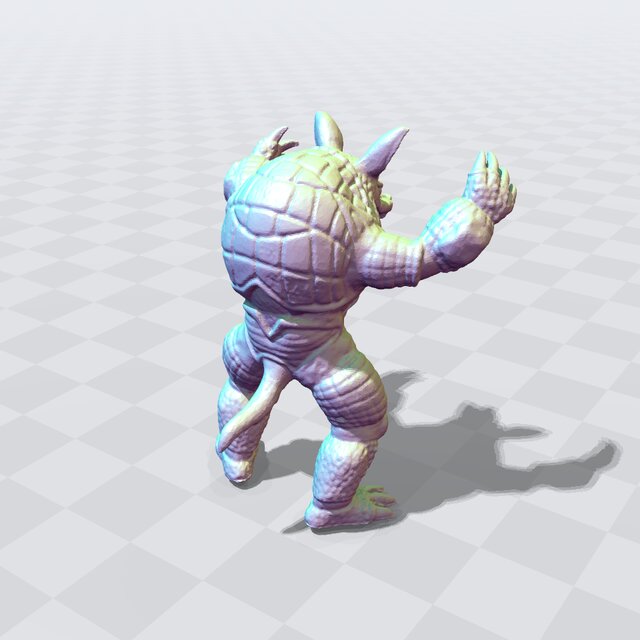
Fig. 24 The armadillo as the viewer first shows it.
The code that runs on either side
The query handed to GPU::transform holds a
TriMeshSDF by value. A mesh SDF owns no memory:
it is a descriptor of a mesh and a BVH that live in a
Pool, so copying it into a kernel is cheap, once it
describes a pool the device can read.
Read the mesh
The mesh comes from the command line or, by default, armadillo.obj from the
common-3d-test-models submodule (see Obtaining EBGeometry). Any watertight, orientable mesh in STL,
PLY, VTK or OBJ works. Each of the three readers in
EBGeometry_Parser.hpp parses the file into one pool:
readIntoFlatMeshSDF: a FlatMeshSDF, the half-edge mesh with no acceleration. Every query visits every face.readIntoMeshSDF: a MeshSDF, the half-edge mesh under a BVH, for any planar convex polygon faces.readIntoTriMeshSDF: aTriMeshSDF, triangles grouped for SIMD under a BVH. Usually the fastest, and the one to pick unless you need the polygon faces themselves.
An application would pick one. The pool must outlive every SDF built into it, and every copy of one.
The example reads with Parser::OnDefect::Warn, so a mesh with small defects (two faces oriented
against each other, or an edge shared by more than two faces, as in the xyzrgb dragon) loads with a
warning instead of being refused; the sign of the distance near such a defect is unreliable.
Use it on the host
The program evaluates all three at the same random points around the mesh and prints the time per
query. The values are the same; only the number of faces visited differs: the flat scan visits every
face, a BVH only the few near the point, so on a large mesh such as the armadillo the BVH-backed
representations are far faster.
getClosestFace(point) (ClosestFace) also
returns which face is nearest, as its index in the file, which is how to look up per-face data of
your own.
Tip
SDF query cost depends on both the geometry and the query point. A tessellated sphere has a “blind spot” at its center where even a BVH must visit most faces.
The same query on a GPU
A kernel cannot read host memory, so the pool goes to the device first:
pool.freeze();                                                       // nothing more is added
const Pool devicePool = Pool::mirror(pool, GPU::memoryResource());   // one copy of everything
const Distance query{triSDF.rebasedView(devicePool)};                // resolves against the copy

std::vector<T> onDevice(points.size());

GPU::transform(query, points, onDevice);
GPU::memoryResource() is device memory in a CUDA or HIP build, and host memory standing in for
it otherwise, so these lines run in both builds. See Memory model and
Running queries on a GPU.
Looking at it
The example ends by opening a window on the mesh:
EBGeometry::Render::view(triSDF, pool, argc, argv);
The window needs SDL2 and is built with make VIEWER=SDL2 or cmake -DEBGEOMETRY_VIEWER=SDL2 (see
The viewer window (EBGEOMETRY_VIEWER)); otherwise, and with --no-view or without a display, view() prints why
and returns. Drag to orbit and scroll to zoom; the window lists its other keys (see
The viewer’s keys). A surface seen from inside the solid is drawn red, which is also how a mesh whose
faces are wound the wrong way looks from outside. TriMeshSDF is ray traced, so the window follows the
mouse; see The renderer and the viewer. The example passes the pool the mesh lives in, so in a GPU build the
window renders on the GPU (G switches to the CPU and back); build in single precision
(PRECISION=float) there, since many GPUs are much slower in double precision.
Building and running
See Building for how to compile it, and Running on a GPU for a GPU build.
cd Examples/MeshSDF
./MeshSDF.ex                                            # defaults to armadillo.obj
./MeshSDF.ex ../../common-3d-test-models/data/cow.obj   # or pick another mesh
./MeshSDF.ex --no-view                                  # without the window