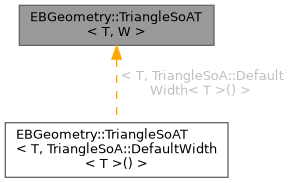
SoA (Structure of Arrays) layout for W triangles, enabling SIMD evaluation. More...
#include <EBGeometry_TriangleSoA.hpp>
Public Member Functions | |
| template<class Meta > | |
| void | pack (const Triangle< T, Meta > *tris, uint32_t count) noexcept |
| Pack count triangles from tris[0..count-1] into this SoA group. | |
| T | signedDistance (const Vec3T< T > &a_point) const noexcept |
| Evaluate signed distance from a_point to the closest triangle in this group. | |
| std::array< T, W > | signedDistances (const Vec3T< T > &a_point) const noexcept |
| Signed distances from a_point to every one of the W lane triangles. | |
| template<class BV > | |
| BV | computeBoundingVolume () const noexcept |
| Compute the bounding volume enclosing all valid triangles in this group. | |
Protected Member Functions | |
| T | signedDistanceLane (uint32_t a_lane, const Vec3T< T > &a_point) const noexcept |
| Signed distance from a_point to the single triangle stored in lane a_lane. | |
Protected Attributes | |
| T | m_vx [3][W] |
| x-coordinates of vertex positions. m_vx[i][j] = x-coord of vertex i for triangle j. | |
| T | m_vy [3][W] |
| y-coordinates of vertex positions. m_vy[i][j] = y-coord of vertex i for triangle j. | |
| T | m_vz [3][W] |
| z-coordinates of vertex positions. m_vz[i][j] = z-coord of vertex i for triangle j. | |
| T | m_nx [W] |
| x-components of face normals. m_nx[j] = x-component of the face normal for triangle j. | |
| T | m_ny [W] |
| y-components of face normals. | |
| T | m_nz [W] |
| z-components of face normals. | |
| T | m_vnx [3][W] |
| x-components of vertex normals. m_vnx[i][j] = x of vertex normal i for triangle j. | |
| T | m_vny [3][W] |
| y-components of vertex normals. m_vny[i][j] = y of vertex normal i for triangle j. | |
| T | m_vnz [3][W] |
| z-components of vertex normals. m_vnz[i][j] = z of vertex normal i for triangle j. | |
| T | m_enx [3][W] |
| x-components of edge normals. m_enx[i][j] = x of edge normal i for triangle j. | |
| T | m_eny [3][W] |
| y-components of edge normals. m_eny[i][j] = y of edge normal i for triangle j. | |
| T | m_enz [3][W] |
| z-components of edge normals. m_enz[i][j] = z of edge normal i for triangle j. | |
| uint32_t | m_validCount = 0 |
| Number of valid (non-padded) triangles in this group (1..W). | |
Detailed Description
SoA (Structure of Arrays) layout for W triangles, enabling SIMD evaluation.
signedDistance() dispatches to a packed intrinsics path for (T,W) combinations that fill a SIMD register exactly — SSE4.1 (float, W=4), AVX (float, W=8; double, W=4 or W=8), or AVX-512F (float, W=16; double, W=8) — evaluating all W triangles simultaneously. Any other (T,W) falls back to a scalar loop over m_validCount triangles.
- Warning
- This type is over-aligned (up to 64 bytes, for AVX-512F) via alignas. The library's own usage (PackedBVH storing groups inside a std::vector<TriangleSoAT>) is safe: C++17 mandates that std::allocator respect over-alignment, which has been verified empirically for every (T,W) combination this class supports. If you allocate a TriangleSoAT yourself outside of that path — a raw
new, a container with a custom/pre-C++17-style allocator, placement-new into externally-owned storage, or amalloc'd buffer — you are responsible for ensuring the memory is aligned toalignof(TriangleSoAT<T, W>); nothing in this class enforces or checks that, and a misaligned SIMD load will crash (or silently read the wrong data on some platforms) rather than failing gracefully.
- Template Parameters
-
T Floating-point precision. W SIMD width: 4 for SSE (128-bit), 8 for AVX (256-bit float) or AVX-512F (512-bit double), 16 for AVX-512F (512-bit float).
Member Function Documentation
◆ computeBoundingVolume()
|
noexcept |
Compute the bounding volume enclosing all valid triangles in this group.
Requires the group to have already been packed via pack() (1 <= m_validCount <= W).
- Template Parameters
-
BV Bounding volume type (e.g. AABBT<T>); must be constructible from a std::vector<Vec3T<T>> of vertex positions.
- Returns
- Bounding volume enclosing all vertices of the m_validCount triangles.
◆ pack()
|
noexcept |
Pack count triangles from tris[0..count-1] into this SoA group.
Pads lanes count..W-1 by repeating the last real triangle so that all W lanes hold valid data and SIMD loads never read uninitialised memory.
- Template Parameters
-
Meta Triangle meta-data type (forwarded from Triangle<T,Meta>).
- Parameters
-
[in] tris Source triangle array with at least count elements. Must not be null. [in] count Number of valid triangles to pack. Must satisfy 1 <= count <= W.
◆ signedDistance()
|
noexcept |
Evaluate signed distance from a_point to the closest triangle in this group.
Returns the signed distance with minimum absolute value among m_validCount triangles. Dispatches to an SSE4.1 packed-float path for (T=float, W=4), to AVX packed-float for (T=float, W=8), to AVX packed-double for (T=double, W=4 or W=8), or to a scalar fallback. Requires the group to have already been packed via pack() (1 <= m_validCount <= W).
- Parameters
-
[in] a_point Query point. Must be finite.
- Returns
- Signed distance from a_point to the closest valid triangle, with sign determined by the outward normal of the nearest feature (face, edge, or vertex).
◆ signedDistanceLane()
|
protectednoexcept |
Signed distance from a_point to the single triangle stored in lane a_lane.
The scalar per-lane kernel shared by the scalar fallback of signedDistance() and by signedDistances(). Reads only lane a_lane's coordinates/normals; performs no reduction.
- Parameters
-
[in] a_lane Lane index. Must satisfy 0 <= a_lane < W. [in] a_point Query point.
- Returns
- Signed distance from a_point to lane a_lane's triangle, sign from its nearest feature.
◆ signedDistances()
|
noexcept |
Signed distances from a_point to every one of the W lane triangles.
The per-lane analogue of signedDistance(): signedDistance() horizontally reduces the W per-triangle distances to the single minimum-|value| entry, whereas this returns all W of them so a caller can recover which lane won – the piece the SIMD reduction discards. Computed with a scalar per-lane loop rather than the SIMD kernel, since it is used only by the metadata-retrieving (non-throughput) path. All W lanes are filled: padded lanes (m_validCount..W-1) repeat the last real triangle's distance, matching pack()'s padding, so a caller iterating lanes should stop at m_validCount (or de-duplicate). Requires the group to have already been packed via pack() (1 <= m_validCount <= W).
- Parameters
-
[in] a_point Query point. Must be finite.
- Returns
- Per-lane signed distances, one per W lanes.
Member Data Documentation
◆ m_validCount
|
protected |
Number of valid (non-padded) triangles in this group (1..W).
Zero-initialized so that a default-constructed (not-yet-packed) group reliably fails the EBGEOMETRY_EXPECT(m_validCount >= 1) precondition in signedDistance() and computeBoundingVolume(), rather than reading whatever indeterminate value happened to be there.
The documentation for this struct was generated from the following file:
- Source/EBGeometry_TriangleSoA.hpp