|
|
uint32_t | m_width = 960 |
| | Image width in pixels.
|
| |
|
uint32_t | m_height = 960 |
| | Image height in pixels.
|
| |
|
uint32_t | m_supersampling = 2 |
| | Rays per pixel along each axis (n x n per pixel), from 1 to 15; the cost views trace one.
|
| |
|
uint32_t | m_threads = 0 |
| | Host threads for render(); 0 uses one per hardware thread.
|
| |
|
bool | m_shadows = true |
| | Soft shadows cast by the shape.
|
| |
|
bool | m_occlusion = true |
| | Ambient occlusion: darker creases and corners.
|
| |
|
bool | m_floor = true |
| | A floor just under the shape, perpendicular to the camera's up axis (only under a shape that is bounded below).
|
| |
|
Backdrop | m_backdrop = Backdrop::Sky |
| | What is drawn behind the shape.
|
| |
|
ColorBy | m_colorBy = ColorBy::Normal |
| | How surfaces are colored.
|
| |
|
Vec3T< T > | m_color = Vec3T<T>(T(0.80), T(0.42), T(0.18)) |
| | The surface color for ColorBy::Uniform (linear RGB in [0, 1]).
|
| |
|
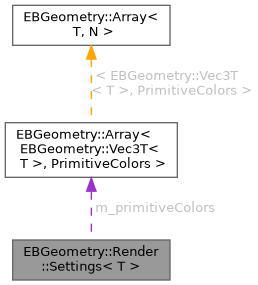
Array< Vec3T< T >, PrimitiveColors > | m_primitiveColors = unsetColors() |
| | Colors for ColorBy::Primitive by primitive id (linear RGB in [0, 1]): entry i colors primitive i. An entry left unset (a negative component, as all are by default), and every id from PrimitiveColors on, takes the built-in palette's color.
|
| |
|
Array< Vec3T< T >, PrimitiveColors > | m_materialColors = unsetColors() |
| | Colors of the materials of a view of regions, for the section plane's fill (m_sectionFill), by material number (linear RGB in [0, 1]), whatever the surfaces are colored by. An entry left unset, and every number from PrimitiveColors on, takes the built-in palette's color, as the surfaces colored by material do.
|
| |
|
bool | m_recordPrimitives = false |
| | Whether a render records each pixel's object in Image::m_primitives (for a viewer's pick outline); off, the image's m_primitives stays empty and a render stores and copies less per pixel.
|
| |
|
uint32_t | m_highlightPrimitive = NoPrimitive |
| | A primitive to highlight (see HitT::m_primitive): its surface is tinted with m_highlightColor, whatever the coloring. NoPrimitive highlights none, AllPrimitives the whole shape.
|
| |
|
uint32_t | m_highlightCount = 1U |
| | How many keys are highlighted, from m_highlightPrimitive on (several selected surfaces, each its own key, so that each is outlined).
|
| |
|
Vec3T< T > | m_highlightColor = Vec3T<T>(T(1.0), T(0.72), T(0.10)) |
| | The highlight's color.
|
| |
|
Vec3T< T > | m_insideColor = Vec3T<T>(T(0.90), T(0.08), T(0.08)) |
| | The color a surface seen from inside the solid is tinted towards.
|
| |
|
Vec3T< T > | m_cutColor = Vec3T<T>(T(0.95), T(0.86), T(0.50)) |
| | The color of faces cut by the section plane when coloring by primitive; otherwise a cut face is colored as a surface facing along the plane's normal would be (or uniformly).
|
| |
|
T | m_cutOpacity = T(1) |
| | Opacity of the cut face (1: opaque): below 1, the shape's next surface behind it along the ray shows through, seen from inside the solid without the inside tint (cavities, bores, the far wall).
|
| |
|
T | m_seenThroughOpacity = T(0.3) |
| | Opacity of the surfaces of a view of regions that are seen through (RegionSettings::setSeenThrough()): drawn translucent over what lies behind them, up to four along each ray, the nearest ones; 0 leaves them out. What is picked or highlighted is drawn solid. However opaque they are drawn, a pick passes through them.
|
| |
|
T | m_ghostOpacity = T(0) |
| | Opacity of the shape on the side the section plane removes (m_section), drawn over what the cut shows: the first surface a camera ray meets there, translucent, so that the kept side and the plane show through it. The plane's fill (m_sectionFill) then covers only the cut, and outside the shape the plane is the sheet. 0 (the default) leaves the removed side out.
|
| |
|
Vec3T< T > | m_floorColor = Vec3T<T>(T(0.58), T(0.59), T(0.61)) |
| | The floor's color.
|
| |
|
bool | m_lightFromCamera = true |
| | Whether m_light is given in the camera's frame (x to the image's right, y to its top, z towards the viewer), so that the light turns with the camera and the side in view stays lit; otherwise it is a direction in the scene.
|
| |
|
Vec3T< T > | m_light = Vec3T<T>(T(-0.45), T(0.75), T(0.55)) |
| | Direction towards the light (need not be of unit length): in the camera's frame with m_lightFromCamera (by default from above, to the left and in front), in the scene's otherwise.
|
| |
|
T | m_lightIntensity = T(1.05) |
| | How strongly the light lights a surface facing it (the diffuse term's factor).
|
| |
|
T | m_ambient = T(0.35) |
| | How much light comes from the sky, on a surface facing up (the ambient term's factor).
|
| |
| T | m_fillIntensity = T(0.35) |
| | How strongly the fill light lights a surface facing it, not negative (0: no fill light).
|
| |
| T | m_shoulder = T(0.8) |
| | Where the brightness of lit surfaces starts to roll off towards white, from 0 to 1 (1: no roll-off, clipped at 1).
|
| |
|
T | m_specular = T(0.45) |
| | How bright the light's highlights are (0: a matte surface).
|
| |
|
T | m_shininess = T(32) |
| | How small the light's highlights are: the specular exponent, at least 1 (larger: a shinier surface).
|
| |
|
Vec3T< T > | m_skyHorizon = Vec3T<T>(T(0.82), T(0.84), T(0.88)) |
| | The sky's color at the horizon.
|
| |
|
Vec3T< T > | m_skyZenith = Vec3T<T>(T(0.32), T(0.45), T(0.66)) |
| | The sky's color straight up.
|
| |
|
Vec3T< T > | m_background = Vec3T<T>(T(0.16), T(0.17), T(0.19)) |
| | The background of Backdrop::Plain.
|
| |
|
Vec3T< T > | m_gradientFrom = Vec3T<T>(T(0.40), T(0.50), T(0.68)) |
| | Backdrop::Gradient's color at the top of the view, Backdrop::Vignette's at its center.
|
| |
|
Vec3T< T > | m_gradientTo = Vec3T<T>(T(0.93), T(0.95), T(0.97)) |
| | Backdrop::Gradient's color at the bottom of the view, Backdrop::Vignette's at its corners.
|
| |
|
FloorStyle | m_floorStyle = FloorStyle::Checker |
| | How the floor is drawn.
|
| |
|
T | m_floorCellSize = T(0) |
| | The side of the floor's checker squares, or the spacing of its grid lines; 0 takes a sixth of the scene's length scale.
|
| |
|
Vec3T< T > | m_floorLineColor = Vec3T<T>(T(0.40), T(0.43), T(0.49)) |
| | The color of the floor's grid lines (FloorStyle::Grid).
|
| |
|
uint32_t | m_floorMajorEvery = 4 |
| | Every how many grid lines one is heavier (FloorStyle::Grid); 0 draws them all alike.
|
| |
|
T | m_floorFade = T(6) |
| | How far the floor reaches before it has faded into the backdrop, in the scene's length scales (the diagonal of the shape's box): it is seen at exp(-(t / (m_floorFade scale))^2) along a camera ray at distance t.
|
| |
|
T | m_floorReflectance = T(0.5) |
| | How much of the shape the floor reflects (FloorStyle::Mirror), from 0 to 1, looking straight down at it; more towards the horizon.
|
| |
|
T | m_lightSize = T(0.04) |
| | The light's size: its width as seen from the shape, as a fraction of its distance (about 0.017 a degree). With supersampling, a pixel's rays each see the light from a different point of a disc of this width, which softens the edges of the shadows; a preview of one ray per pixel draws them hard.
|
| |
|
bool | m_section = false |
| | Whether the section plane cuts the shape.
|
| |
|
Vec3T< T > | m_sectionPoint = Vec3T<T>::zeros() |
| | A point on the section plane.
|
| |
|
Vec3T< T > | m_sectionNormal = Vec3T<T>(T(0), T(0), T(1)) |
| | The section plane's normal: the part of the shape on the side it points to is removed.
|
| |
|
T | m_contourWidth = T(3.5) |
| | Width in pixels of the line drawn on the section plane where it meets the shape's surface (the shape's contour in the plane); 0 draws none.
|
| |
|
Vec3T< T > | m_contourColor = Vec3T<T>(T(0.04), T(0.04), T(0.05)) |
| | The contour's color.
|
| |
|
T | m_isoSpacing = T(0) |
| | Spacing of lines of equal signed distance drawn on the section plane, inside and outside the shape (0: none). Spaced like a simulation grid, they show what the grid resolves. Where they would lie only a few pixels apart on screen, every second is left out, as often as needed: farther along a plane seen at a slant, fewer are drawn, and a line can end where the next is left out.
|
| |
|
Vec3T< T > | m_isoColor = Vec3T<T>(T(0.10), T(0.11), T(0.13)) |
| | The color of those lines: outside the shape, drawn over the sheet (m_sheetOpacity), as strongly as the sheet is clear.
|
| |
|
Vec3T< T > | m_isoSecondaryColor = Vec3T<T>(T(0.60), T(0.12), T(0.10)) |
| | The color of those lines where a shape marks them secondary: a view of regions showing a whole domain, in the regions it excludes (RegionSettings::m_sectionDomain).
|
| |
|
bool | m_isoSecondary = false |
| | Whether lines of equal distance are drawn where a shape marks them secondary (where a view of regions' domain or subdomain does not compute); the zero line is drawn either way.
|
| |
|
T | m_sheetOpacity = T(0.35) |
| | Opacity of the section plane where it lies outside the shape, within the shape's box: a frosted sheet that shows where the plane is, edged by a line where it meets the box (0: none, 1: opaque).
|
| |
|
T | m_sectionFill = T(1) |
| | Opacity of the section plane's fill by what each point of it is in, within the shape's box (0: none, 1: opaque): a shape's sectionKey(point) (a view of regions: the material of the region there), in its material's color (m_materialColors, else the palette); gray where the region has no material, and where a domain shown on the plane does not compute (m_fillSecondaryColor). Where it fills, it takes the sheet's place. Shapes without a key are not filled.
|
| |
|
bool | m_sectionFillOutside = true |
| | Whether the fill (m_sectionFill) also covers the plane outside the shape, within its box (a view of regions: outside its visible regions, where the regions hidden lie); false fills only the cut, as a CAD section does.
|
| |
|
Vec3T< T > | m_fillSecondaryColor = Vec3T<T>(T(0.45), T(0.45), T(0.47)) |
| | The fill's color where a shape marks the field secondary (where a view of regions' domain or subdomain does not compute): not computed, whatever the material.
|
| |
|
Vec3T< T > | m_sheetColor = Vec3T<T>(T(0.95), T(0.96), T(0.97)) |
| | The sheet's color.
|
| |
|
Vec3T< T > | m_sheetEdgeColor = Vec3T<T>(T(0.45), T(0.47), T(0.50)) |
| | The color of the sheet's edge.
|
| |
|
RayOptions< T > | m_rays |
| | How rays march (see firstHit()). A scale of 0 takes the shape's box diagonal, or the camera distance for an unbounded shape.
|
| |
|
ViewMode | m_viewMode = ViewMode::Shaded |
| | What the render shows.
|
| |
|
T | m_xrayOpacity = T(0.25) |
| | In ViewMode::XRay, how opaque each surface a ray crosses is, from 0 to 1: how brightly it glows, and how much of what lies behind it it hides. Its highlights follow m_specular and m_shininess, at half strength.
|
| |
|
Array< uint32_t, HiddenPrimitives > | m_hidden = noneHidden() |
| | Primitives to see through (see HitT::m_primitive): a camera ray that meets one goes on as if it were not there, and the surface behind it is shaded as one seen from outside; it casts no shadow and no ambient occlusion either. The solid's inside is the whole shape's. NoPrimitive marks an unused entry.
|
| |
|
uint32_t | m_peel = 0 |
| | How many surfaces each camera ray passes before the one it shows, peeling the frame layer by layer (0: the first, below Renderer::MaxCrossings). Every crossing counts, entering or leaving, a cut face too; a surface seen through (m_hidden) does not. The surface shown is shaded as one seen from outside, and what lies in front of it is left out (the section plane's drawing too); where a ray meets fewer surfaces, the floor or the backdrop shows. In the x-ray view, the surfaces peeled do not glow; the depth view and a pick see the surface shown. Shadows and ambient occlusion are the whole shape's.
|
| |
|
uint32_t | m_volumePrimitive = NoPrimitive |
| | A part (see HitT::m_primitive) whose inside is filled with m_volumeColor wherever it lies along a camera ray, in front of or behind the surface seen; NoPrimitive fills none, AllPrimitives the whole solid. A stretch inside the solid is counted as the part's when the ray enters it through that part's surface.
|
| |
|
Vec3T< T > | m_volumeColor = Vec3T<T>(T(0.10), T(0.75), T(1.0)) |
| | The fill's color.
|
| |
|
RegionSettings | m_regions |
| | How a view of regions (RegionView) is shown: the visible regions, what a surface is colored by, the surfaces shown alone or seen through, and a domain's surface groups. The renderer gives them to the view; other shapes ignore them.
|
| |
|
T | m_volumeOpacity = T(0.7) |
| | The fill's opacity where the part is thickest along a ray, from 0 to 1.
|
| |