|
| bool | isRegionHighlighted (const uint32_t a_region) const noexcept |
| | Whether a region is highlighted.
|
| |
| template<typename T > |
| uint32_t | selectionOf (const SurfaceRef< T > &a_surface) const noexcept |
| | The entry of the selection a surface is selected by.
|
| |
| bool | isSurfaceGroupHidden (const uint32_t a_group) const noexcept |
| | Whether a surface group is hidden.
|
| |
| void | setSurfaceGroupHidden (const uint32_t a_group, const bool a_hidden) noexcept |
| | Hide a surface group, or show it again.
|
| |
| bool | isSurfaceGroupSeenThrough (const uint32_t a_group) const noexcept |
| | Whether a surface group is seen through (m_throughGroups).
|
| |
| void | setSurfaceGroupSeenThrough (const uint32_t a_group, const bool a_through) noexcept |
| | See through a surface group, or make it opaque again.
|
| |
| bool | isVisible (const uint32_t a_region, const uint32_t a_numRegions) const noexcept |
| | Whether a region is shown (the background never is).
|
| |
| void | setVisible (const uint32_t a_region, const bool a_visible) noexcept |
| | Show or hide a region.
|
| |
| void | showOnly (const uint32_t a_region) noexcept |
| | Show one region and hide the others.
|
| |
| bool | isSeenThrough (const uint32_t a_key) const noexcept |
| | Whether the surfaces with a key are seen through.
|
| |
| void | setSeenThrough (const uint32_t a_key, const bool a_through) noexcept |
| | See through the surfaces of a key, or make them opaque again (at most MaxSeenThrough keys; beyond them, none is added).
|
| |
| bool | isRegionSeenThrough (const uint32_t a_region) const noexcept |
| | Whether a region is seen through (m_throughRegions).
|
| |
| void | setRegionSeenThrough (const uint32_t a_region, const bool a_through) noexcept |
| | See through a region, or make it opaque again (regions from 64 on are left as they are).
|
| |
|
void | clearSeenThrough () noexcept |
| | Make every surface opaque: no key, no region and no surface group seen through.
|
| |
| void | setColoring (const RegionColoring a_coloring) noexcept |
| | Color and name surfaces by another key; the keys shown alone and seen through, which meant another thing, are cleared. The regions and surface groups seen through (m_throughRegions, m_throughGroups) do not depend on the coloring and are kept.
|
| |
|
|
uint64_t | m_hidden = 0U |
| | The hidden regions, a bit each (bit k for region k); regions from 64 on are always shown.
|
| |
|
RegionColoring | m_coloring = RegionColoring::Region |
| | What a surface is colored and named by.
|
| |
|
uint32_t | m_only = None |
| | The key shown alone, or None.
|
| |
|
uint32_t | m_through [MaxSeenThrough] = {None, None, None, None, None, None, None, None} |
| | The keys seen through; None marks an unused entry.
|
| |
|
uint64_t | m_throughRegions = 0U |
| | The regions seen through, a bit each (bit k for region k; regions from 64 on never are): every surface shown as the region's, whatever the coloring, as the keys of m_through are.
|
| |
|
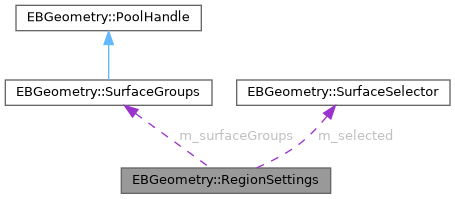
SurfaceGroups | m_surfaceGroups |
| | A solver's groups of surfaces (RegionColoring::SurfaceGroup colors by them): a view of selectors in a pool (a domain's, Domain::surfaceGroups(), or one built on its own), which must outlive the settings and, for a render on a device, be rebased onto that pool's mirror. Empty by default.
|
| |
|
uint32_t | m_highlightGroup = None |
| | The surface group whose surfaces are highlighted (keyed Highlighted), or None.
|
| |
|
uint64_t | m_highlightRegions = 0U |
| | The highlighted regions, a bit each (bit k for region k, the background's bit 0 included): every surface with one of them on either side is keyed Highlighted, whatever the coloring (a subdomain's boundary, say).
|
| |
|
SurfaceSelector | m_selected [MaxSelected] = {} |
| | The selected surfaces, the first m_numSelected entries (a viewer's picked parts or regions): a surface one of them matches is keyed Selected and its entry, whatever the coloring.
|
| |
|
uint32_t | m_numSelected = 0U |
| | How many entries of m_selected are used.
|
| |
|
bool | m_onlySelected = false |
| | Whether only the selected surfaces are shown, all of them, those other surfaces hid included, each side keyed apart: Selected + entry where the view enters the region seen, Selected + MaxSelected + entry where it leaves it (a surface's back, seen through an open end). A viewer renders so to outline each selected surface along its own edges: where its key changes, at its silhouette and at its rims.
|
| |
|
uint64_t | m_sectionRegions = 0U |
| | The regions whose function the section plane shows (its fill and contours, and the value under a viewer's cursor), a bit each (bit k for region k, the background's bit 0 included): a subdomain's, what a cut-cell code cuts for it (Tape::signedDistance(p, subdomains, subdomain)); 0 for the visible regions'.
|
| |
|
bool | m_sectionDomain = false |
| | Whether the section plane shows a whole domain: at each point the function of its own subdomain (its region's, m_sectionSubdomains, or the excluded regions'), negative in it and zero on its boundary, so that every subdomain's lines show at once and its zero line is every boundary and interface; the excluded regions' lines are secondary (ContourSample). Before m_sectionRegions.
|
| |
|
uint8_t | m_sectionSubdomains [64] = {} |
| | With m_sectionDomain, each region's subdomain (regions 0 to 63; later ones are excluded): below 32, or ExcludedSubdomain.
|
| |
|
uint32_t | m_hiddenGroups = 0U |
| | The hidden surface groups, a bit each (bit g for surface group g): their surfaces are not drawn, and cast no shadow.
|
| |
|
uint32_t | m_throughGroups = 0U |
| | The surface groups seen through, a bit each (bit g for surface group g): their surfaces drawn translucent and passed through, as the keys of m_through are.
|
| |
|
|
static constexpr uint32_t | None = 0xFFFFFFFFU |
| | No key.
|
| |
|
static constexpr uint32_t | MaxSeenThrough = 8 |
| | How many keys can be seen through at once.
|
| |
|
static constexpr uint32_t | Highlighted = 0xFFFFFFFDU |
| | The key a view of regions gives the surfaces of the highlighted surface group (m_highlightGroup), whatever the coloring, for a renderer to highlight (Render::Settings::m_highlightPrimitive).
|
| |
|
static constexpr uint32_t | MaxSelected = 16 |
| | How many selectors the selection holds at most.
|
| |
|
static constexpr uint32_t | Selected = 0xFFFFFFC0U |
| | The key of the first selected surface: a surface entry i of the selection matches first (see m_selected) is keyed Selected + i, whatever the coloring, so that each is told apart (and outlined) and all are highlighted together (Render::Settings::m_highlightPrimitive = Selected, m_highlightCount = m_numSelected).
|
| |
|
static constexpr uint8_t | ExcludedSubdomain = 0xFFU |
| | An entry of m_sectionSubdomains: the region is in no subdomain (Domain::Excluded).
|
| |
How the regions of an object are shown (see RegionView): which regions are visible, what a surface is colored and named by, the surfaces shown alone or seen through, and a domain's surface groups.
A plain value, part of the render settings (Render::Settings::m_regions), so that a render, a viewer and a saved view share one description, and a kernel takes it. Keys are by the coloring: a region's number, a material's, a surface label's, a surface's, a part's, an interface's (interfaceKey()) or a group's.