The tape's arrays as offsets into its pool, with no location (see PoolHandle). More...
#include <EBGeometry_Tape.hpp>
Collaboration diagram for EBGeometry::Tape< T, UserPrimitives >::Layout:
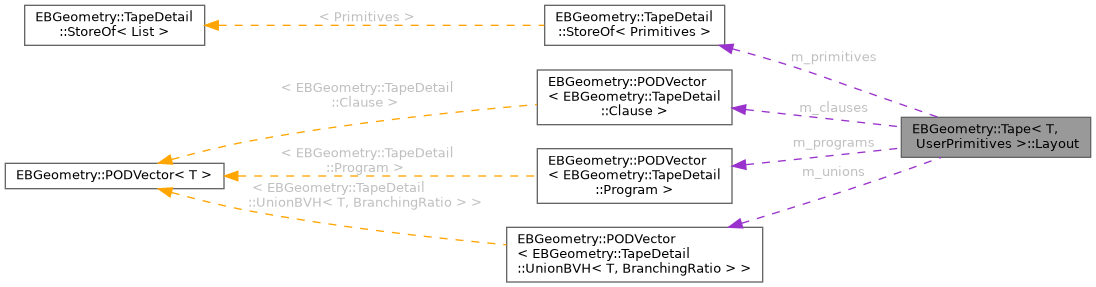
Public Attributes | |
| TapeDetail::StoreOf< Primitives >::type | m_primitives |
| One array per primitive type. | |
| PODVector< TapeDetail::Clause > | m_clauses |
| The clauses of every sub-program, one after another. | |
| PODVector< TapeDetail::Program > | m_programs |
| Each sub-program's clause range; sub-program 0 is the whole object. After the m_numPrograms sub-programs come the clause ranges a ray marches (see TapeDetail::RayOp::Marched), then from m_rayPrograms on each sub-program's ray program, whose clauses (TapeDetail::RayClause, stored as clauses) follow the sub-programs' in m_clauses, and after those each sub-program's parent, the sub-program it was compiled for, in m_begin (UINT32_MAX for sub-program 0; m_end unused). The ray programs begin in program order, which rayLeafHit() relies on to find a clause's by bisection. | |
| PODVector< T > | m_params |
| Constant parameters the clauses refer to. | |
| PODVector< TapeDetail::UnionBVH< T, BranchingRatio > > | m_unions |
| The BVH unions. | |
| BV | m_boundingVolume |
| A box enclosing the object. | |
| DistanceQuality | m_quality = DistanceQuality::NotADistance |
| How far the value can be trusted as a distance. | |
| uint32_t | m_callDepth = 0 |
| How deep sub-program calls nest from sub-program 0. | |
| uint32_t | m_numPrograms = 0 |
| How many sub-programs there are (the first entries of m_programs). | |
| uint32_t | m_numPrimitives = 0 |
| How many primitives (leaves) the tape has, each occurrence counted. | |
| uint32_t | m_largestPlainUnion = 0 |
| The most objects in one union evaluated as written (see getLargestPlainUnion()). | |
| uint32_t | m_rayPrograms = 0 |
| Where in m_programs the ray programs begin: sub-program i's is entry m_rayPrograms + i (an empty range for one a ray never follows). | |
| PODVector< uint32_t > | m_surfaceLabels |
| Each leaf's label (see getSurfaceLabel()); empty when the expression has no Label. | |
| PODVector< uint32_t > | m_surfaces |
| Each leaf's first surface, and the number of surfaces last (see getFirstSurface()); empty when no leaf is a container, each leaf then being one surface, numbered as the leaf. | |
| PODVector< uint32_t > | m_partSurfaceLabels |
| The part labels (see SurfaceLabel(shape, FaceGroups)): first, per leaf, where its parts' labels begin in this array (None for a leaf whose parts are not named); then those labels. Empty when no leaf's parts are. | |
| PODVector< uint32_t > | m_regionPrograms |
| The regions: the number n of the Overlays' operands (0 without an Overlay), then each operand's record's offset, then each region's material (the background first; two for an object with no Overlay), then the records: the number m of masks above the region, their numbers (outermost first), and its m + 1 programs, the solid with every mask and then with the outermost 1, 2, ..., m left out. Empty without the feature. | |
| uint32_t | m_numLabels = 0 |
| How many distinct labels the expression has. | |
Detailed Description
template<class T, class... UserPrimitives>
struct EBGeometry::Tape< T, UserPrimitives >::Layout
The tape's arrays as offsets into its pool, with no location (see PoolHandle).
The documentation for this struct was generated from the following file:
- Source/EBGeometry_Tape.hpp
