The names of an object's regions, materials, surfaces and surface labels, from its expression's index, and of surface groups: what a viewer shows a piece of surface or a group by (Render::view()). More...
#include <EBGeometry_RegionNames.hpp>
Public Member Functions | |
| RegionNames ()=default | |
| No names: everything is named by its number. | |
| template<class T > | |
| RegionNames (const ExprIndex< T > &a_index) | |
| The names an expression's index gives: a region by its name and its material ("2 wall (steel)"), a surface by its label (or its number). | |
| uint32_t | addDomain (std::string a_name, const DomainSetup &a_domain) |
| Register a domain: its name, and how it is made (its subdomains and surface groups, see DomainSetup). The first registered is the active one, whose surface groups the names name and a viewer shows. | |
| uint32_t | getNumDomains () const noexcept |
| How many domains are registered. | |
| DomainSetup & | getDomain (const uint32_t a_domain) |
| How a domain is made, to edit. | |
| const DomainSetup & | getDomain (const uint32_t a_domain) const |
| How a domain is made. | |
| const std::string & | domainName (const uint32_t a_domain) const |
| A domain's name. | |
| void | setActiveDomain (const uint32_t a_domain) |
| Make a domain the active one: the one whose surface groups setSurfaceGroup() and surfaceGroup() name. | |
| uint32_t | getActiveDomain () const noexcept |
| The active domain. | |
| void | setSurfaceGroup (const uint32_t a_domain, const uint32_t a_group, std::string a_name) |
| Name a surface group of a domain. | |
| void | setSubdomain (const uint32_t a_domain, const uint32_t a_subdomain, std::string a_name) |
| Name a subdomain of a domain ("fluid", "solid"). | |
| std::string | subdomain (const uint32_t a_subdomain, const bool a_number=true) const |
| A subdomain's name in the active domain, with its number or not: "1 solid" or "solid"; "subdomain 1". | |
| void | setColor (std::string a_name, const Vec3T< double > &a_color) |
| Give a name a color: a region's, a material's, a surface label's or a surface group's. Colored by that kind of key, its surfaces take it; others take the palette's. | |
| bool | colorOf (const RegionColoring a_coloring, const uint32_t a_key, Vec3T< double > &a_color) const |
| The color a key has, colored by a kind of key: by the name of the region, material, surface label (a surface's too) or surface group it is. Colored by region, a region without a color of its own takes its material's, so that colors given to materials (the usual case) are kept when the coloring turns to regions. | |
| const SurfaceInventory & | getInventory () const noexcept |
| What the index says about the surfaces: every surface, its parts, the pairs of regions it may separate (see possiblePieces(), coverageOf()). | |
| uint32_t | materialOf (const uint32_t a_region) const noexcept |
| A region's material. | |
| void | setSurface (const uint32_t a_surface, std::string a_name) |
| Name a surface (by default it is named by its label): where it comes from, say ("cylinder, model.ebg:6"). | |
| void | setPickedByLabel (const uint32_t a_surface, const bool a_byLabel=true) |
| Pick a surface by its labels rather than its parts: a click on it picks the faces labeled as the one clicked (a mesh's face group), or the whole surface when the face has no label of its own. For a mesh, whose parts are its faces, which a model names only through its face groups. | |
| bool | pickedByLabel (const uint32_t a_surface) const noexcept |
| Whether a surface is picked by its labels (see setPickedByLabel()). | |
| void | setSurfaceGroup (const uint32_t a_group, std::string a_name) |
| Name a surface group of the active domain (with no domain registered, of those a viewer shows). | |
| void | removeSurfaceGroup (const uint32_t a_group) |
| Forget a group's name; the names of the groups after it move down by one (as SurfaceGroups::removeSurfaceGroup() numbers them). | |
| std::string | region (const uint32_t a_region, const bool a_number=true) const |
| A region's name and material, with its number or not: "2 wall (steel)" or "wall (steel)"; the background is "background", a region without a name "region 2". | |
| std::string | material (const uint32_t a_material, const bool a_number=true) const |
| A material's name, with its number or not. | |
| std::string | surface (const uint32_t a_surface, const bool a_number=true) const |
| A surface's name, with its number or not: its label's, or "surface 3". | |
| std::string | surfaceLabel (const uint32_t a_label, const bool a_number=true) const |
| A surface label's name, with its number or not. | |
| std::string | surfaceGroup (const uint32_t a_group, const bool a_number=true) const |
| A surface group's name, with its number or not: "0 inlet" or "inlet"; "surface group 0". | |
Static Public Attributes | |
| static constexpr uint32_t | None = 0xFFFFFFFFU |
| No material, no label. | |
Protected Member Functions | |
| std::vector< std::string > & | groupNames () noexcept |
| The surface groups' names in use: the active domain's, or, with no domain, the names' own. | |
| const std::vector< std::string > & | groupNames () const noexcept |
| The surface groups' names in use. | |
Static Protected Member Functions | |
| static std::string | named (const std::vector< std::string > &a_names, const uint32_t a_index, const char *a_kind, const bool a_number) |
| A name from a list, after its number, or the kind and the number. | |
Protected Attributes | |
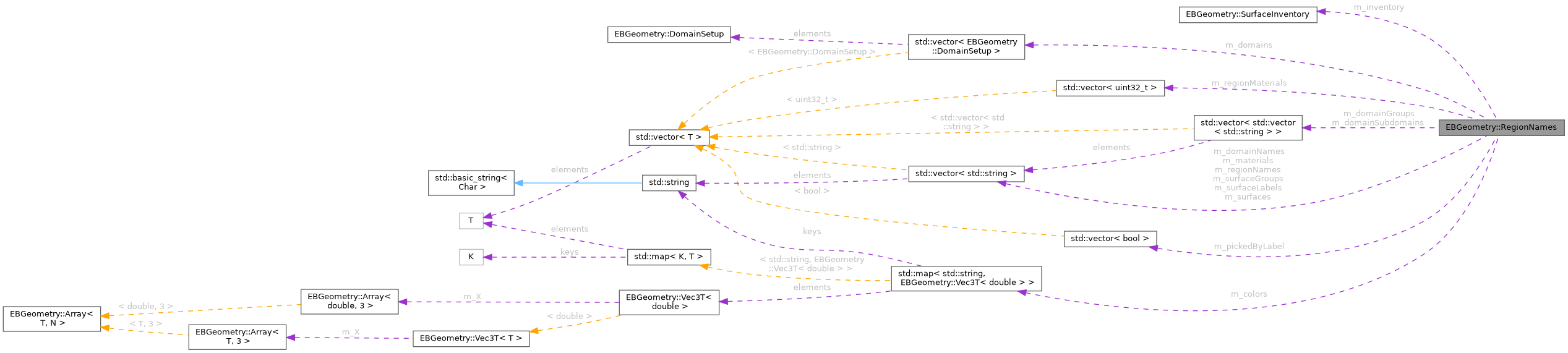
| SurfaceInventory | m_inventory |
| The surfaces, from the index. | |
| std::vector< DomainSetup > | m_domains |
| The domains, their names and their surface groups' names; and the active one, or None. | |
| std::vector< std::string > | m_domainNames |
| The domains' names. | |
| std::vector< std::vector< std::string > > | m_domainSubdomains |
| Each domain's subdomains' names. | |
| std::vector< std::vector< std::string > > | m_domainGroups |
| Each domain's surface groups' names. | |
| uint32_t | m_activeDomain = None |
| The active domain, or None. | |
| std::vector< std::string > | m_regionNames |
| The regions' own names (RegionName()), empty for none; the lists below too leave the unnamed empty. | |
| std::vector< uint32_t > | m_regionMaterials |
| Each region's material label number, or None. | |
| std::map< std::string, Vec3T< double > > | m_colors |
| The colors given to names. | |
| std::vector< std::string > | m_materials |
| The materials' names. | |
| std::vector< std::string > | m_surfaces |
| The surfaces' names. | |
| std::vector< bool > | m_pickedByLabel |
| Which surfaces are picked by their labels (see setPickedByLabel()). | |
| std::vector< std::string > | m_surfaceLabels |
| The surface labels' names. | |
| std::vector< std::string > | m_surfaceGroups |
| The groups' names. | |
Detailed Description
The names of an object's regions, materials, surfaces and surface labels, from its expression's index, and of surface groups: what a viewer shows a piece of surface or a group by (Render::view()).
Host only. Anything without a name, or beyond the lists, is named by its kind and number ("region 3", "surface group 1"). Names can also be given colors (setColor()), which a viewer colors the surfaces by.
Constructor & Destructor Documentation
◆ RegionNames()
|
inlineexplicit |
The names an expression's index gives: a region by its name and its material ("2 wall (steel)"), a surface by its label (or its number).
- Template Parameters
-
T Floating-point precision.
- Parameters
-
[in] a_index The index of the expression the tape was compiled from.
Member Function Documentation
◆ addDomain()
|
inline |
Register a domain: its name, and how it is made (its subdomains and surface groups, see DomainSetup). The first registered is the active one, whose surface groups the names name and a viewer shows.
- Parameters
-
[in] a_name Its name ("heat transfer"). [in] a_domain How it is made.
- Returns
- Its number, from 0 in the order registered.
◆ colorOf()
|
inline |
The color a key has, colored by a kind of key: by the name of the region, material, surface label (a surface's too) or surface group it is. Colored by region, a region without a color of its own takes its material's, so that colors given to materials (the usual case) are kept when the coloring turns to regions.
- Parameters
-
[in] a_coloring The kind of key. [in] a_key The key. [out] a_color Its color, if it has one.
- Returns
- Whether it has one.
◆ domainName()
|
inline |
◆ getActiveDomain()
|
inlinenoexcept |
The active domain.
- Returns
- Its number, or None when none is registered.
◆ getDomain() [1/2]
|
inline |
How a domain is made, to edit.
- Parameters
-
[in] a_domain Its number (below getNumDomains()).
- Returns
- Its setup.
◆ getDomain() [2/2]
|
inline |
◆ getInventory()
|
inlinenoexcept |
What the index says about the surfaces: every surface, its parts, the pairs of regions it may separate (see possiblePieces(), coverageOf()).
- Returns
- The inventory; empty for names not built from an index.
◆ getNumDomains()
|
inlinenoexcept |
How many domains are registered.
- Returns
- The count.
◆ groupNames() [1/2]
|
inlineprotectednoexcept |
The surface groups' names in use.
- Returns
- The names.
◆ groupNames() [2/2]
|
inlineprotectednoexcept |
The surface groups' names in use: the active domain's, or, with no domain, the names' own.
- Returns
- The names.
◆ material()
|
inline |
A material's name, with its number or not.
- Parameters
-
[in] a_material The material label's number. [in] a_number Whether to put its number first.
- Returns
- The name.
◆ materialOf()
|
inlinenoexcept |
A region's material.
- Parameters
-
[in] a_region The region.
- Returns
- The material label's number, or None.
◆ named()
|
inlinestaticprotected |
A name from a list, after its number, or the kind and the number.
- Parameters
-
[in] a_names The list. [in] a_index The number. [in] a_kind What it is. [in] a_number Whether to put the number before a name.
- Returns
- The name.
◆ pickedByLabel()
|
inlinenoexcept |
Whether a surface is picked by its labels (see setPickedByLabel()).
- Parameters
-
[in] a_surface The surface.
- Returns
- Whether it is.
◆ region()
|
inline |
A region's name and material, with its number or not: "2 wall (steel)" or "wall (steel)"; the background is "background", a region without a name "region 2".
- Parameters
-
[in] a_region The region. [in] a_number Whether to put its number first.
- Returns
- The name.
◆ removeSurfaceGroup()
|
inline |
Forget a group's name; the names of the groups after it move down by one (as SurfaceGroups::removeSurfaceGroup() numbers them).
- Parameters
-
[in] a_group The group.
◆ setActiveDomain()
|
inline |
Make a domain the active one: the one whose surface groups setSurfaceGroup() and surfaceGroup() name.
- Parameters
-
[in] a_domain Its number (below getNumDomains()).
◆ setColor()
|
inline |
Give a name a color: a region's, a material's, a surface label's or a surface group's. Colored by that kind of key, its surfaces take it; others take the palette's.
- Parameters
-
[in] a_name The name ("steel", "wall", "inlet"). [in] a_color Its color, linear RGB in [0, 1] (as Render::Settings::m_color).
◆ setPickedByLabel()
|
inline |
Pick a surface by its labels rather than its parts: a click on it picks the faces labeled as the one clicked (a mesh's face group), or the whole surface when the face has no label of its own. For a mesh, whose parts are its faces, which a model names only through its face groups.
- Parameters
-
[in] a_surface The surface. [in] a_byLabel Whether it is picked by its labels.
◆ setSubdomain()
|
inline |
Name a subdomain of a domain ("fluid", "solid").
- Parameters
-
[in] a_domain The domain (below getNumDomains()). [in] a_subdomain The subdomain (its number in the domain's Subdomains). [in] a_name Its name.
◆ setSurface()
|
inline |
Name a surface (by default it is named by its label): where it comes from, say ("cylinder, model.ebg:6").
- Parameters
-
[in] a_surface The surface. [in] a_name Its name.
◆ setSurfaceGroup() [1/2]
|
inline |
Name a surface group of a domain.
- Parameters
-
[in] a_domain The domain. [in] a_group The surface group. [in] a_name Its name: the boundary condition's tag.
◆ setSurfaceGroup() [2/2]
|
inline |
Name a surface group of the active domain (with no domain registered, of those a viewer shows).
- Parameters
-
[in] a_group The group. [in] a_name Its name.
◆ subdomain()
|
inline |
A subdomain's name in the active domain, with its number or not: "1 solid" or "solid"; "subdomain 1".
- Parameters
-
[in] a_subdomain The subdomain. [in] a_number Whether to put its number first.
- Returns
- The name.
◆ surface()
|
inline |
A surface's name, with its number or not: its label's, or "surface 3".
- Parameters
-
[in] a_surface The surface (SurfaceRef::m_surface). [in] a_number Whether to put its number first.
- Returns
- The name.
◆ surfaceGroup()
|
inline |
A surface group's name, with its number or not: "0 inlet" or "inlet"; "surface group 0".
- Parameters
-
[in] a_group The group. [in] a_number Whether to put its number first.
- Returns
- The name.
◆ surfaceLabel()
|
inline |
A surface label's name, with its number or not.
- Parameters
-
[in] a_label The label's number. [in] a_number Whether to put its number first.
- Returns
- The name.
The documentation for this class was generated from the following file:
- Source/EBGeometry_RegionNames.hpp
