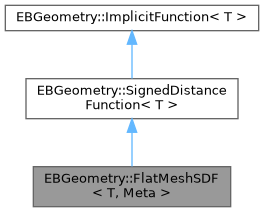
Signed distance function for a DCEL mesh. Does not use BVHs. More...
#include <EBGeometry_MeshDistanceFunctions.hpp>

Classes | |
| struct | Layout |
| The object's arrays as offsets into its pool, with no location (see PoolHandle). More... | |
Public Types | |
| using | Mesh = EBGeometry::DCEL::MeshT< T > |
| Alias for DCEL mesh type. | |
Public Member Functions | |
| FlatMeshSDF ()=delete | |
| Disallowed constructor. | |
| FlatMeshSDF (const Layout &a_layout, const PoolLocation &a_location) noexcept | |
| Rebuild a handle from a stored layout and the location of the pool that holds it. | |
| Layout | layout () const noexcept |
| The object's arrays without its location, for storing it inside another pool-resident object. | |
| FlatMeshSDF (const Mesh &a_mesh, Pool &a_pool) noexcept | |
| Full constructor. | |
| T | signedDistance (const Vec3T< T > &a_point) const noexcept |
| Compute the signed distance from a_point to the mesh. | |
| ClosestFace< T > | getClosestFace (const Vec3T< T > &a_point) const noexcept |
| Find the face closest to a_point, and the signed distance to it. | |
| Mesh | getMesh () const noexcept |
| Get the underlying DCEL mesh descriptor. | |
| FlatMeshSDF | rebasedView (const Pool &a_pool) const noexcept |
Produce a copy of this object that resolves against a_pool. | |
| FlatMeshSDF | deepCopy (Pool &a_dstPool) const |
Duplicate the mesh's storage into a_dstPool. | |
| EBGeometry::BoundingVolumes::AABBT< T > | computeBoundingVolume () const noexcept |
| Compute the AABB enclosing the entire mesh. | |
 Public Member Functions inherited from EBGeometry::PoolHandle | |
| PoolLocation | location () const noexcept |
| Where this handle's arrays live. | |
| bool | isAttachedTo (const Pool &a_pool) const noexcept |
Check whether this handle's arrays were reserved from a_pool. | |
Static Public Attributes | |
| static constexpr DistanceQuality | distanceQuality = DistanceQuality::Exact |
| How far signedDistance() can be trusted as a distance: the Euclidean distance to a watertight mesh. | |
Additional Inherited Members | |
| Protected Member Functions inherited from EBGeometry::PoolHandle | |
| PoolHandle () noexcept=default | |
| An unset location; the first reservation attaches it. | |
| PoolHandle (const PoolLocation &a_location) noexcept | |
| Adopt a location, as a handle rebuilt from a stored layout does. | |
| PoolHandle (const PoolHandle &) noexcept=default | |
| Copy a handle, as a derived handle's copy does. | |
| PoolHandle (PoolHandle &&) noexcept=default | |
| Move a handle; the same as a copy. | |
| PoolHandle & | operator= (const PoolHandle &) noexcept=default |
| Copy-assign a handle, as a derived handle's assignment does. | |
| PoolHandle & | operator= (PoolHandle &&) noexcept=default |
| Move-assign a handle; the same as a copy. | |
| ~PoolHandle () noexcept=default | |
| Destructor; protected, since a PoolHandle exists only as the base of a handle. | |
| void * | base () noexcept |
| The base address this handle's offsets resolve against; see PoolLocation::base(). | |
| const void * | base () const noexcept |
| The base address this handle's offsets resolve against, for read-only access. | |
| void | attach (const Pool &a_pool, const char *a_who) noexcept |
Follow a_pool, as the first reservation does; see PoolLocation::attach(). | |
| PoolLocation | rebasedLocation (const Pool &a_pool, uint64_t a_endByte, const char *a_who) const noexcept |
| The location of this handle's arrays in another pool of its mirror chain; see PoolLocation::rebasedOnto(). | |
| void | setLocation (const PoolLocation &a_location) noexcept |
| Replace the location, for a view or a copy made by a derived handle. | |
Detailed Description
class EBGeometry::FlatMeshSDF< T >
Signed distance function for a DCEL mesh. Does not use BVHs.
Iterates over every face of the mesh on every query – O(N) per call. Suitable only for very small meshes, debugging, and as a brute-force reference for the BVH-accelerated mesh SDFs.
A plain value type: it holds the mesh descriptor by value (offsets into a Pool plus the pool's control block or base address) and nothing else, so it is trivially copyable and every query is callable on the host and on a device. It has no virtual functions: a class with them can never be passed to a kernel.
It visits every face, so on the 100,000-face armadillo the BVH-backed mesh SDFs are hundreds of times faster.
Copying a FlatMeshSDF copies descriptors only: every copy resolves against the same pool memory, and the pool must outlive all of them. A FlatMeshSDF sees the mesh as it was when it was constructed; build a new one after changing the mesh's size. To evaluate on a device, freeze and mirror the pool, then pass rebasedView() into a kernel:
- Template Parameters
-
T Floating-point precision type (float or double).
Constructor & Destructor Documentation
◆ FlatMeshSDF() [1/2]
|
inlinenoexcept |
Rebuild a handle from a stored layout and the location of the pool that holds it.
How an outer pool-resident object, such as a BVHUnion, evaluates a FlatMeshSDF it stores as a layout. a_location must belong to the pool the layout was reserved from, or to a mirror of it; nothing is checked, since a device has no pool to check against.
- Parameters
-
[in] a_layout The arrays. [in] a_location Where they live.
◆ FlatMeshSDF() [2/2]
|
inlinenoexcept |
Full constructor.
Copies the mesh descriptor. Nothing is frozen or bound: the mesh resolves its storage through a_pool's control block on every access, so this object is queryable at once and stays queryable across a Pool::reserve that grows and moves the block. a_pool is taken to check that a_mesh really was reserved from it, and to make visible at the call site that it must outlive this object and every copy of it.
- Parameters
-
[in] a_mesh Input mesh, built against a_pool. [in,out] a_pool Pool a_mesh's storage was reserved from. Must outlive this object.
Member Function Documentation
◆ computeBoundingVolume()
|
inlinenoexcept |
Compute the AABB enclosing the entire mesh.
A componentwise min/max over the mesh vertices, so it is callable on host and device alike. An empty mesh yields an inverted box (low corner +max, high corner -max).
- Returns
- Axis-aligned bounding box of the mesh.
◆ deepCopy()
|
inline |
Duplicate the mesh's storage into a_dstPool.
The copy constructor copies descriptors only, leaving both objects resolving against the same pool memory. This is the operation that gives genuinely independent storage.
- Parameters
-
[in,out] a_dstPool Pool to reserve the copy's mesh from; may be this object's own pool.
- Returns
- A FlatMeshSDF over an independent copy of the mesh, attached to
a_dstPool.
◆ getClosestFace()
|
inlinenoexcept |
Find the face closest to a_point, and the signed distance to it.
Scans every face with the rule of DCEL::MeshT::SearchAlgorithm::Direct2, the mesh's default: the face with the smallest unsigned distance wins.
- Parameters
-
[in] a_point Query point. Must be finite.
- Returns
- The closest face's id (its index in the mesh) and signed distance. The signed distance equals what signedDistance() returns for the same point, unless the mesh's search algorithm was changed (DCEL::MeshT::setSearchAlgorithm()).
◆ getMesh()
|
inlinenoexcept |
Get the underlying DCEL mesh descriptor.
- Returns
- The mesh.
◆ layout()
|
inlinenoexcept |
The object's arrays without its location, for storing it inside another pool-resident object.
- Returns
- The layout.
◆ rebasedView()
|
inlinenoexcept |
Produce a copy of this object that resolves against a_pool.
Rebases the mesh descriptor; see DCEL::MeshT::rebasedView() for the contract. This is the one sanctioned crossing to a device.
- Parameters
-
[in] a_pool Pool to rebase onto: the object's own pool or one in its mirror chain.
- Returns
- A FlatMeshSDF resolving against
a_pool.
◆ signedDistance()
|
inlinenoexcept |
Compute the signed distance from a_point to the mesh.
- Parameters
-
[in] a_point Query point.
- Returns
- Signed distance to the nearest face; negative inside the mesh.
The documentation for this class was generated from the following file: