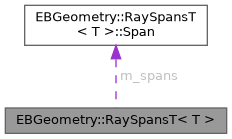
Where a ray is inside an object over an interval [t0, t1]: its spans, in order, each from where it enters to where it leaves, complete up to a horizon.
More...
#include <EBGeometry_Ray.hpp>
|
| struct | Span |
| | A span: where the ray enters, and where it leaves. More...
|
| |
|
| void | reset (T a_horizon) noexcept |
| | Empty the list, complete up to a horizon.
|
| |
| void | add (const SpanEndT< T > &a_in, const SpanEndT< T > &a_out) noexcept |
| | Append a span after the last one, or, if the list is full, drop it and lower the horizon to where it begins.
|
| |
| void | addClipped (T a_in, T a_out, T a_t0, T a_t1) noexcept |
| | Append the span [a_in, a_out] cut to [a_t0, a_t1]: an end outside it (or infinite) becomes an Open end there. Nothing is added if the span misses the interval.
|
| |
|
|
Span | m_spans [Capacity] |
| | The spans, in order and disjoint.
|
| |
|
uint32_t | m_count = 0 |
| | How many are held.
|
| |
|
T | m_horizon = Math::Limits<T>::infinity() |
| | The list is complete on [t0, m_horizon]: nothing about the object beyond it is known.
|
| |
|
|
static constexpr uint32_t | Capacity = 8 |
| | Most spans held.
|
| |
template<class T>
struct EBGeometry::RaySpansT< T >
Where a ray is inside an object over an interval [t0, t1]: its spans, in order, each from where it enters to where it leaves, complete up to a horizon.
A span that begins before t0 begins at t0 with an Open end, and one that ends after t1 ends at t1 with an Open end. The list holds at most Capacity spans. Past that, add() drops a span and lowers the horizon to where it begins: the list is then complete only on [t0, m_horizon], and a query needing more starts again from the horizon. A shape whose ray form only finds the first crossing (see RayForm) describes the interval up to it in the same way.
- Template Parameters
-
| T | Floating-point precision. |
◆ add()
Append a span after the last one, or, if the list is full, drop it and lower the horizon to where it begins.
- Parameters
-
| [in] | a_in | Where the ray enters. |
| [in] | a_out | Where it leaves. |
◆ addClipped()
Append the span [a_in, a_out] cut to [a_t0, a_t1]: an end outside it (or infinite) becomes an Open end there. Nothing is added if the span misses the interval.
- Parameters
-
| [in] | a_in | Where the ray enters (or -infinity); above a_out for a ray that misses. |
| [in] | a_out | Where it leaves (or +infinity). |
| [in] | a_t0 | Start of the interval. |
| [in] | a_t1 | End of the interval. |
◆ reset()
Empty the list, complete up to a horizon.
- Parameters
-
| [in] | a_horizon | Horizon: the end of the interval, for a list that will be complete. |
The documentation for this struct was generated from the following file: