Building blocks for builds that run with GPU::parallelFor(): a bounding-box reduction, a bitonic sort and an exclusive scan. More...
#include <cmath>#include <cstddef>#include <cstdint>#include <type_traits>#include "EBGeometry_BoundingVolumes.hpp"#include "EBGeometry_GPU.hpp"#include "EBGeometry_GPURuntime.hpp"#include "EBGeometry_GPUTransform.hpp"#include "EBGeometry_Macros.hpp"#include "EBGeometry_Math.hpp"#include "EBGeometry_Vec.hpp"
Include dependency graph for EBGeometry_GPUAlgorithms.hpp:

This graph shows which files directly or indirectly include this file:
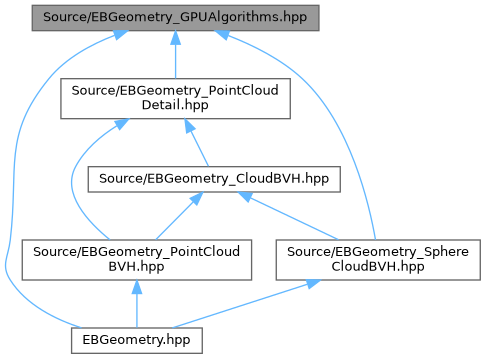
Go to the source code of this file.
Classes | |
| struct | EBGeometry::GPU::AlgorithmsDetail::FromPointer< T > |
| boundingBox()'s source for an array of points. More... | |
| struct | EBGeometry::GPU::AlgorithmsDetail::ChunkBox< T, Source > |
| boundingBox(), pass 1: the box of each chunk of points. More... | |
| struct | EBGeometry::GPU::AlgorithmsDetail::MergeChunks< T > |
| boundingBox(), pass 2: one thread merges the chunk boxes into chunk 0's. One thread is enough at the sizes the builds see (a few thousand chunks); a cloud near the 2^31-point limit would want a tree of merges. More... | |
| struct | EBGeometry::GPU::AlgorithmsDetail::BitonicPass< Key, Less > |
| bitonicSort(): one compare-exchange pass, one thread per pair. More... | |
| struct | EBGeometry::GPU::AlgorithmsDetail::ChunkSums |
| exclusiveScan(), pass 1: the sum of each chunk of values. More... | |
| struct | EBGeometry::GPU::AlgorithmsDetail::ScanSums |
| exclusiveScan(), pass 2: one thread turns the chunk sums into each chunk's offset, and the total after them. More... | |
| struct | EBGeometry::GPU::AlgorithmsDetail::ScanChunks |
| exclusiveScan(), pass 3: each chunk's values replaced by their exclusive prefix sums. More... | |
| struct | EBGeometry::GPU::Ascending |
| The order operator< gives, as a trivially copyable functor callable on a device. More... | |
Namespaces | |
| namespace | EBGeometry |
| Namespace containing all of EBGeometry's functionality. | |
| namespace | EBGeometry::GPU |
| Backend-neutral GPU runtime API surface (CUDA or HIP). | |
| namespace | EBGeometry::GPU::AlgorithmsDetail |
| The functors behind boundingBox() and bitonicSort(). | |
Functions | |
| uint32_t | EBGeometry::GPU::exclusiveScanScratchSize (const uint32_t a_count) noexcept |
Scratch elements exclusiveScan() needs for a_count values: one per chunk, and one for the total. | |
| uint32_t | EBGeometry::GPU::boundingBoxScratchSize (const uint32_t a_count) noexcept |
Scratch elements boundingBox() needs for a_count points: two corners per chunk. | |
| template<class T , class Source > | |
| BoundingVolumes::AABBT< T > | EBGeometry::GPU::boundingBoxOf (const Source &a_points, const uint32_t a_count, Vec3T< T > *a_scratch) |
| The smallest box holding every point, from a source of points: one box per chunk of BoundingBoxChunk points, then one thread merging them. | |
| template<class T > | |
| BoundingVolumes::AABBT< T > | EBGeometry::GPU::boundingBox (const Vec3T< T > *a_points, const uint32_t a_count, Vec3T< T > *a_scratch) |
| The smallest box holding an array of points; see boundingBoxOf(). | |
| template<class Key , class Less = Ascending> | |
| void | EBGeometry::GPU::bitonicSort (Key *a_keys, const uint32_t a_count, const Less &a_less=Less()) |
Sort a_count keys in place with a bitonic network: log2(n) (log2(n) + 1) / 2 passes of n / 2 compare-exchanges each. | |
| uint32_t | EBGeometry::GPU::exclusiveScan (uint32_t *a_values, const uint32_t a_count, uint32_t *a_scratch) |
Replace a_count values by their exclusive prefix sums, in place, and return their total: one sum per chunk of ScanChunk values, one thread scanning the sums, then each chunk scanned from its offset. | |
Variables | |
| constexpr uint32_t | EBGeometry::GPU::ScanChunk = 256 |
| Values per chunk in exclusiveScan()'s passes. | |
| constexpr uint32_t | EBGeometry::GPU::BoundingBoxChunk = 256 |
| Points per chunk in boundingBox()'s first pass. | |
Detailed Description
Building blocks for builds that run with GPU::parallelFor(): a bounding-box reduction, a bitonic sort and an exclusive scan.
Each runs one or more GPU::parallelFor() launches, so it runs on the device in a CUDA or HIP translation unit and as host loops otherwise, and returns once the work is done. The arrays they read and write must be memory the launch can reach: device-accessible in a CUDA or HIP build (device memory will do), and host memory otherwise. They use no atomics, so their results do not depend on thread scheduling.
